Familiar Fundraising Tactics May Be Losing Ground with Gen Z Donors




New research from Georgia State University and University of Texas at Dallas finds that overhead transparency a workhorse of relief fundraising, resonates less strongly with young donors who already have experience giving to international nonprofits.
The Core Finding
Development teams have long relied on two proven tools: telling donors how efficiently their money is used and showing emotionally evocative images of people in need. A new study by Jonathan Oxley (Georgia State University) and Elizabeth A. M. Searing (University of Texas at Dallas) tests how these tools interact and identifies a clear warning signal for organizations cultivating younger donor pipelines.
Among Gen Z participants in a lab experiment at GSU, exposure to both fundraising tools together produced a weaker response than among a nationally representative adult sample. The gap was not random. It was driven almost entirely by one group: young donors who already had personal or family experience giving to international relief nonprofits, precisely the audience nonprofits most want to convert into long-term supporters.
In the national sample, donors chose the appeal combining overhead information and emotional imagery at nearly 3-to-1 over a control appeal. Among experienced Gen Z donors in the lab, that advantage narrowed considerably to 2-to-1.
What the Research Did
Oxley and Searing ran two parallel experiments. The first was conducted at GSU's ExCEN behavioral economics laboratory with 342 student participants, a predominantly Gen Z sample. The second used CloudResearch's Connect platform to recruit 352 adults matched to the broader U.S. population.
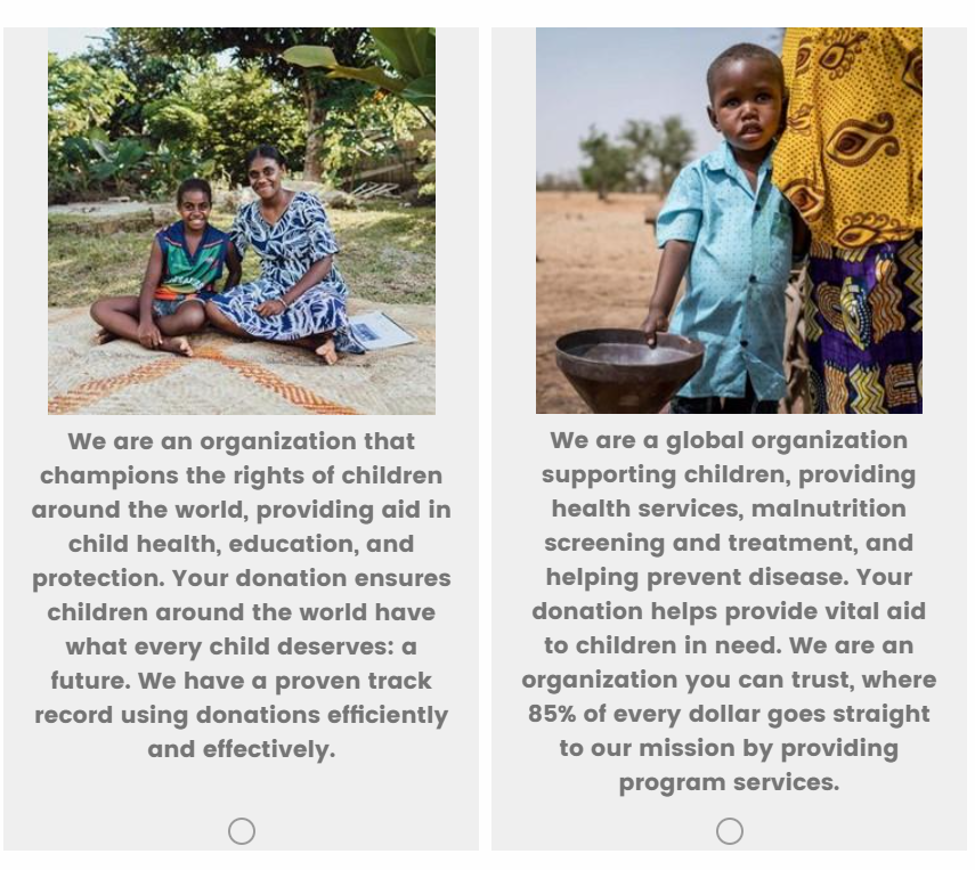
In both experiments, participants chose between two fundraising appeals from Save the Children (used with the organization's permission). Across four treatment conditions, the appeals varied whether they included a specific overhead percentage ("85% of every dollar goes to program services") and whether they included emotionally charged versus neutral imagery of a mother and child.
Critically, this was not an “intent to donate” study. After choosing an appeal, participants completed a real-effort task, adding and subtracting two-digit numbers, to earn real money. They then decided how much of their actual earnings to donate to Save the Children. In total, the two experiments raised $920.49 for the organization.
What the Numbers Show
Across both experiments, once a participant selected an appeal, donation amounts were largely similar regardless of which appeal they chose. The meaningful differences showed up earlier in which appeal attracted donors in the first place.
In the national Connect sample, participants selected the combined overhead-and-imagery appeal over the control at a rate of 255 to 97, nearly three-to-one. The Gen Z lab sample was more muted: 211 selected the treatment appeal versus 105 for the control, a ratio closer to two-to-one.
When the researchers looked more closely at why the two samples diverged, the answer came into focus: nearly all the difference was concentrated among participants with prior experience giving to international relief nonprofits, either personally or through a family member.
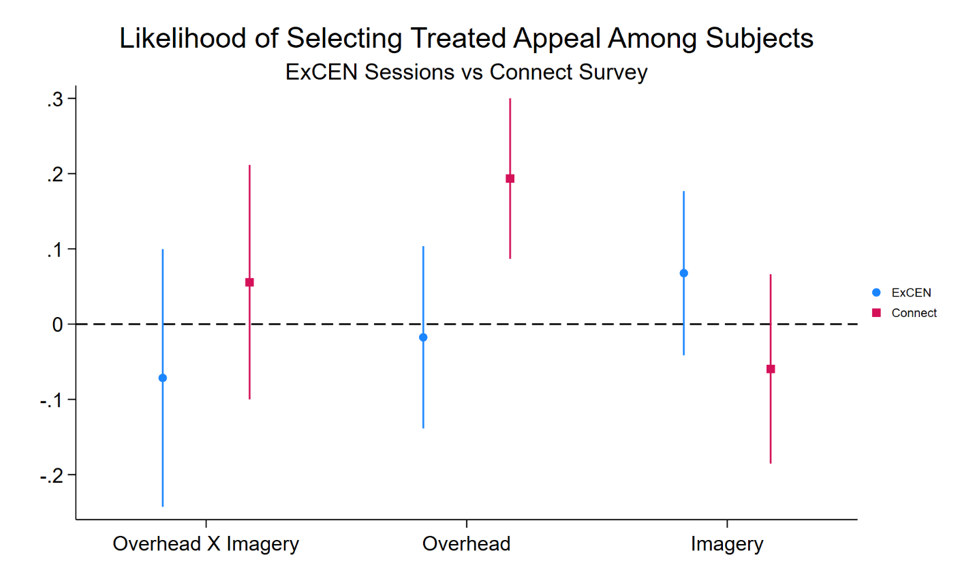
Key Takeaways: Gen Z subjects in the ExCEN lab respond in the opposite manner across the board from a national representative sample from Connect. In particular, Connect subjects were attracted to low overhead. Conversely, emotional imagery had limited impact on appeal selection.
Why Experienced Gen Z Donors Are the Story
Experienced donors are among the most valuable constituents any development team enages. They give more reliably, respond to cultivation, and form the backbone of mid-level and major gift pipelines. The concern raised by this research is not that Gen Z is uncharitable, but rather that the techniques organizations have used for decades to engage experienced donors may not translate to a cohort that has grown up with greater access to an array of social media and a different relationship to institutional trust.
The implication is not to abandon overhead transparency. In the broader adult population, this tool still works. The implication is that organizations investing in Gen Z donor cultivation, particularly among young people who are already giving, may need to test whether the standard playbook is working as expected, and begin developing alternatives if it is not.
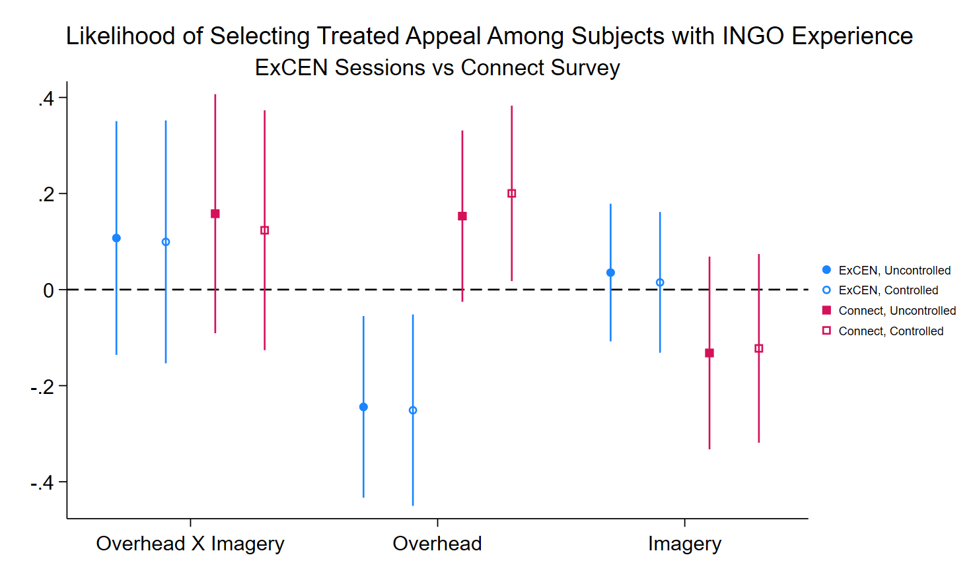
Key Takeaway: The differences between overhead attractions almost exclusively comes from subjects who had experience with international aid nonprofits. If this trend continues, the divergence in fundraising to Gen Z donors will become substantially more pronounced.
What (We Believe) Nonprofits Should Do
A few concrete starting points follow directly from the design of this study. First, the employment of emotionally evocative imagery appears to be less persuasive than traditional fundraising practices would lead one to believe. As using this imagery is not costless, development teams should think carefully before defaulting to it. Second, development teams running A/B tests on Gen Z segments should treat donor generation and prior giving history as a moderating variable, not just demographic controls, since the effect here was concentrated entirely within experienced donors rather than spread evenly across the cohort. For that experienced subgroup, the standard overhead pitch appears to be a turnoff, though more research needs to be done to explain why. First-time Gen Z donors are a different question. They appear to be more in line with traditional responses to high levels of mission-oriented spending based on their appeal selection with overhead information included. Further research is needed to fully understand why this divergence is ongoing. This divergence is unlikely to go away as this cohort continues to age into its prime giving years.
For more information or to speak with the authors, contact:
Jonathan Oxley, Ph.D.
Assistant Professor, Georgia State University
[email protected]
Elizabeth A. M. Searing, Ph.D.
Associate Professor, University of Texas at Dallas
[email protected]
This research was funded by an AFP Foundation Levis Research Grant.

Read More