AFP Member Spotlight: Ruthie Miller




AFP Member Spotlights are a recurring series of interviews with AFP members, highlighting the unique individuals and career paths that exist within the fundraising profession. If you know an inspiring fundraising professional who deserves to be featured, please email [email protected].
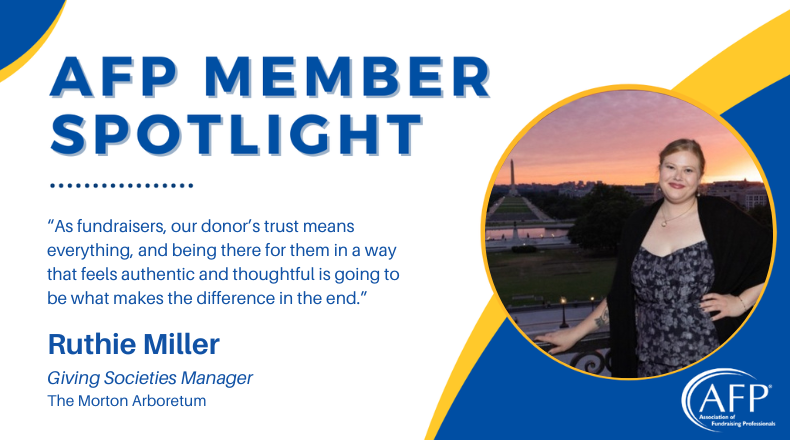
In this member spotlight, we interviewed Ruthie Miller, giving societies manager at The Morton Arboretum. Ruthie shares how her background in arts administration led to a career rooted in building meaningful donor relationships, and how intentional, people-first engagement guides her approach to mid-level giving and cross-team collaboration. She also reflects on the value of AFP connections and mentorship, encouraging fundraisers to stay curious, advocate for themselves, and prioritize authentic human connection.
Q: How did you start your career in the fundraising profession and what led you there?
A: I started my career in fundraising at Ford’s Theatre Society in D.C. as the development associate. I studied arts administration with a focus in music in college at Butler University and connected deeply with development work through my studies and my first internship at the Indianapolis Symphony Orchestra in the role of corporate relations intern. I realized that fundraising and donor relations in particular were a great fit for me because of the amazing conversations I've had and continue to have with members and donors of all levels. Getting to form those relationships while learning what our work and mission means to them is so special.
Q: When and why did you decide to become an AFP member?
A: I became an AFP member at Ford’s Theatre when I transitioned into the role of individual giving and membership manager at the suggestion of my supervisor, and I immediately found so much helpful information and was able to attend AFP ICON 2025 in Seattle. When I started in my current role as giving societies manager at The Morton Arboretum, I knew I wanted to join AFP again, specifically because of the discount for young professionals and variety of programming available for emerging fundraisers.
Q: Are you doing anything innovative at your organization (or a past organization) that you think other fundraisers could benefit from?
A: I am working currently to solidify the identity of our mid-level giving program, working on updates to our marketing materials (a new brochure, website updates etc.) and I am also trying to work closely with our volunteer department to celebrate and inspire volunteers who are already members or donors or who would be interested in getting involved in multiple ways in the future, while celebrating and recognizing that they dedicate their most valuable resource of time already.
Q: What is your favorite word? (only one word) How has this word influenced or inspired your career?
A: I think this changes over time, but the current word that comes to mind is “Intention”. Focusing on being intentional with every ask, every event, and every donor meeting has allowed me to value members and donors of all levels, making sure that communications are catered correctly to the specific group receiving them. “Intention” also helped to inform my career move as I left my old position and started at The Morton Arboretum. Donors can tell if you are not invested in your mission, so I made sure to jump into learning as much as I could about my organization in my first few months. This allows me to be more mindful of the time donors are taking with each interaction, as well as the time I’m taking, and meeting them where they are at.
Q: What professional accomplishment are you most proud of?
A: I was honored to have worked at Ford’s Theatre Society during the launch of the public phase of their campaign for a new building that housed rehearsal space, education space, and donor event space. I worked to involve donors and members through appeals and personal outreach before it was announced to the general public, and included them in the new building festivities wherever possible to make sure their contributions were seen and that I properly stewarded them after their many years of commitment to the organization.
Q: How has being an AFP member and participating in the AFP affinity groups benefited you in your career?
A: I have been able to attend a meeting this year with the emerging leaders affinity group and had an amazing time getting to meet others who are in the first 5-10 years of their career. This space allowed us to ask questions and bring up potential topics of discussion that would not only help us in our own career growth but also help us to work through current challenges or roadblocks at our own organizations. I am looking forward to hopefully attending more meetings with this group and other groups in the future. I am also part of the AFP Chicago chapter mentor program where I am being mentored by a fundraising professional with decades of experience, which has allowed me to ask questions and learn about parts of development outside of mid-level and annual giving.
Q: In your opinion, what is the biggest challenge facing the nonprofit fundraising profession today?
A: I think that in a world where AI is starting to touch parts of every industry, pushing forward the importance of person-to-person connections with donors and recognizing that they want to give to people, not computers. As fundraisers, our donor’s trust means everything, and being there for them in a way that feels authentic and thoughtful is going to be what makes the difference in the end.
Q: What advice do you have for other fundraising professionals?
A: Ask questions! I have learned so much from talking to other fundraisers with more experience than me, and having connections with people in every sector of the nonprofit sphere has expanded my perspective on fundraising as a whole. Another piece of advice would be to advocate for yourself, always. Ask for tips on preventing burnout, ask colleagues for help when you are struggling with a project, take walks if/when you can during your breaks, be your biggest champion and in turn you will inspire others to do the same for themselves.

Read More