The Charitable Act
Back to the Policy & Advocacy Page
Latest Charitable Act News
Signed into law on July 4, 2025, the One Big Beautiful Bill Act (OBBBA) contained the most sweeping tax changes impacting charitable giving in the past few decades. AFP strongly supported inclusion of the bipartisan Charitable Act, which establishes a permanent, above-the-line charitable deduction of up to $1,000 for individuals and $2,000 for couples who do not itemize their taxes. This provision restores a key incentive for the majority of Americans who take the standard deduction and represents a major advocacy success for AFP and the charitable sector.
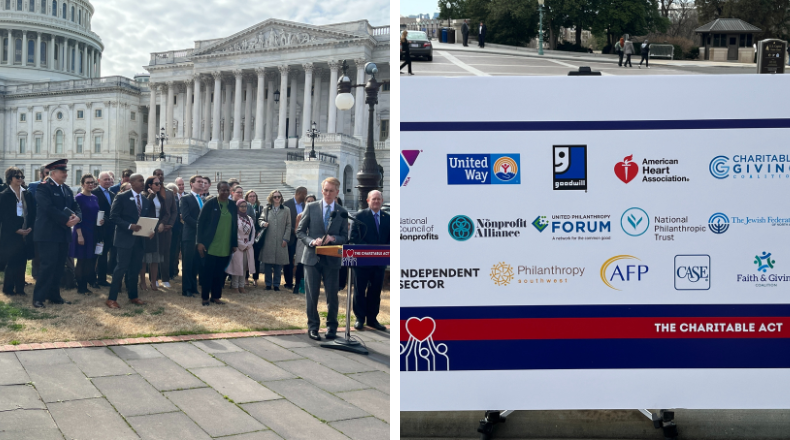
AFP, through its U.S. Government Relations Committee and active participation in the Charitable Giving Coalition, worked to ensure the Charitable Act was advanced while opposing harmful tax proposals that were ultimately removed from the final package. Among those removed were a proposed 10% fee on Combined Federal Campaign contributions, an increase to the private foundation excise tax, new proposed taxes on employee parking benefits, research, and royalties/logos, and measures that would have allowed the executive branch to revoke nonprofit tax-exempt status.
To help fundraising professionals navigate the new giving landscape—including both the opportunities for non-itemizing donors and the new floors and caps affecting itemizers—AFP has developed a series of member resources:
The following articles discuss how AFP Global supported the Charitable Act:
- Giving USA 2023: Help Stop Individual Giving Declines (July 1, 2024)
- AFP Positioned as Leader in Washington, DC on Charitable Giving (February 26, 2024)
- Lend Your Support to the Charitable Act (May 22, 2023)
- AFP Supports Charitable Act to Incentivize Giving (March 2, 2023)
Donate to the AFP Political Action Committee (PAC)
The Association of Fundraising Professionals Political Action Committee is nonpartisan and the oldest PAC focusing on philanthropy and charitable giving. It supports AFP's advocacy priorities in the United States through contributions to members of Congress and candidates for federal office, who champion philanthropy, who have been advocates for our issues in the past, and who are in leadership positions that can help advance what’s important to the philanthropic sector.