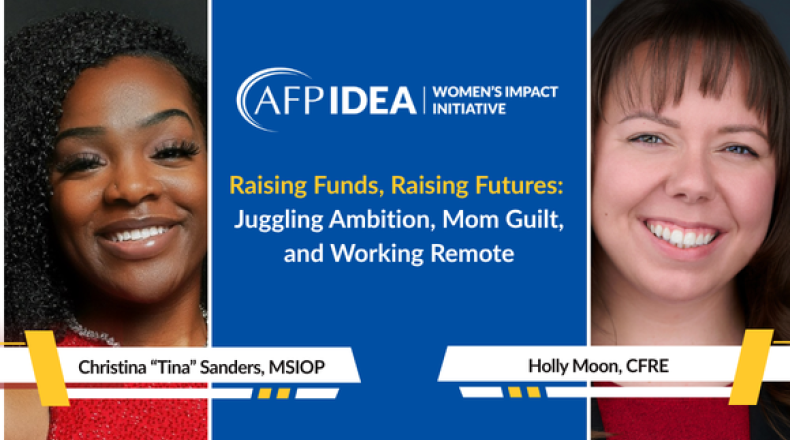
Raising Funds, Raising Futures: Juggling Ambition, Mom Guilt, and Working Remote



In 2022, AFP’s Women’s Impact Initiative launched a storytelling series, The Mental Load of Motherhood, a series of interviews with working moms sharing their experiences balancing parenting with the demands of a fundraising career. Now, the series is back with a new name, Raising Funds, Raising Futures, reflecting a broader range of caregiving experiences in the nonprofit profession.
In this conversation, Holly Moon, CFRE, assistant director, chapter fundraising at the Sierra Club, and Christina “Tina” Sanders, MSIOP, development manager at the Legal Aid Society of Middle Tennessee and the Cumberlands, talk candidly about mom guilt, having the support of employers to work remotely with kids at home, and redefining ambition in the fundraising profession.
Read the article below or watch their full interview here.
Holly and Tina are co-leads for the Working Moms Storytelling Subcommittee for the Women’s Impact Initiative. If you are a woman fundraiser and have a story to share about mothering or caregiving, let us know. We would love to feature you! You can reach us at https://www.linkedin.com/in/tinassanders or https://www.linkedin.com/in/hollymoon.
Q: Tell us about your current day-to-day as a working mom in the fundraising profession.
Moon: It’s going about as well as it possibly can. I work remotely full time while my 3-year-old twins are home full time, so though I do have a partner, I’m often the default parent. My employer is flexible, which I’m grateful for, but I still feel shame sometimes when one of my kids interrupts a meeting needing something. A lot of employers wouldn’t be as understanding though, so I’m fortunate mine values me regardless of my parental status.
I’ve always believed in “work-life integration” over work-life balance. Work doesn’t live inside 9-to-5, and my personal life doesn’t live exclusively outside of it either. There are times I step away because one of my kids is having a meltdown or has a doctor’s appointment, but I make a point of giving that time back, sometimes logging on again after they’ve gone to bed. I’ve also found ways to work alongside taking care of my kids. For example, I’ll take my camping chair and my lap desk outside while the kids play, and I work like that sometimes.
Sanders: I have a 13-year-old son and a 6-year-old son, and I am parenting solo, as my ex-husband is in the military and lives in a different state. I’m fortunate to work for a company that’s very family-centered. There’s flexibility for me to be home with my children if they’re sick, or to adjust my schedule in the summer when childcare isn’t available every day.
I’ve had a similar experience to Holly, where I’ll go to the local indoor play place, which has a coffee shop, and get some work done while my kids play. When I am home and I am at my computer all day, I feel guilty sometimes because my 6-year-old wants me to play with him. He doesn’t understand that I need to sit at the computer and get things done, so having the flexibility to work outside the home, somewhere where he can have fun, helps to relieve some of that mom guilt we all feel.
Q: Holly, you have a partner at home. Tina, you’re parenting solo. What has that looked like for each of you?
Sanders: Parenting alone means there’s no one to “tag in” when meetings run late or events pop up after hours, though I lean on a strong support system, including my mother and godsister. It’s difficult, especially in fundraising, where you have events and meetings after hours. The mental load is heavy. I’ve learned to give myself grace by outsourcing where I can, including grocery delivery and simpler meals. It’s OK for me to spend the extra money on convenience if it protects my mental health and makes sure my household is taken care of.
Moon: I rely on my partner for part of the load, particularly mornings, but I have my own shortcuts, too. When I really don’t want to cook, I’ll take my kids to the local bagel shop. You can’t be perfect at all the things.
Q: Holly, you now work remotely full time with your kids at home, but that wasn’t always the case. Can you tell us what led to the decision to have them home with you?
Moon: I became pregnant with twins while working as a director of development and marketing at a free clinic in Florida. Daycare wasn’t financially realistic on my salary at the time, so I left the job to stay home, a transition that strained my marriage and finances. I had never been unemployed in my adult life until that point. It took me about 10 months before I eventually found a flexible, remote position, which allowed us to enroll the twins in daycare. In December last year, however, we made the difficult decision to take them out of daycare and have them stay home with me. My partner changed jobs, and the cost of having two kids in daycare, which was between $3,000 and $4,000 a month — twice my mortgage — became unsustainable. I consider myself fairly privileged, and I still couldn’t afford to keep my kids in daycare. It’s not the way I would choose to do this, but it’s a reality, and I’m fortunate my employer was gracious about it, because not all employers would be.
Q: Holly, you have first-hand experience working for an employer that was not supportive. Can you share what that was like?
Moon: During a high-risk pregnancy complicated by preeclampsia, my doctor recommended I work from home starting at 30 weeks rather than commute nearly an hour each way. My employer at the time wasn’t set up for remote work and gradually excluded me from meetings and decisions. I was essentially phased out. After an emergency C-section around 36 weeks, communication went silent during my leave, and I had to resign the day I returned because I didn’t yet have a childcare plan in place. It was very difficult to be a mom in that situation, being phased out of your workplace because they weren’t set up for it and weren’t willing to make accommodations. Looking back, I also wish I had felt braver about advocating for myself.
Sanders: You may not have been able to advocate for yourself with that employer, but you did make the choice to leave that job and find someplace that was a better fit, which is also brave. That’s encouraging for anyone who is struggling with finding that support.
Q: Let’s talk about ambition. How has motherhood shaped that for each of you?
Sanders: Ambition has always been a part of who I am; it is woven into my being. I had my oldest son when I was 19 and entering my sophomore year of college, which was challenging. But after I got divorced, I went back to school, pursued my master’s degree, and have continued to charge forward. I do it because I want my sons to see me do my absolute best, to see resilience, not to see life knock me down and me stay stagnant.
Moon: I became a mother later in my career, so my ambition has shifted rather than faded. It’s not all about climbing the ladder anymore. I have to balance what’s best for my kids with my career. I can’t take a great job in another city because that would mean uprooting their lives. Still, I don’t want to be defined only by motherhood. I’m a professional fundraiser. I’m a person who values her community. I want my daughter, especially, to not feel limited by motherhood if she chooses to be a mom.
Q: Was there a moment that changed how you thought about balancing ambition and presence?
Sanders: There was a turning point after my son’s football practice. He told me, ‘Mommy, no other mom has their laptop at my practice. I want you to watch me.’ That really hit me. I realized that saying “yes” to work in that moment was stopping me from being fully present with my child. I’ve become more careful about which opportunities I accept as a result. Every “yes” I give takes away from something else.
Moon: I relate to that tension. Since my kids are young, they get up in the morning, and they want me to go outside and play with them. They don’t understand that I have to work during the day. And sometimes I wish I didn’t have to, but I do love my job and I love working. So, it’s hard.
Q: Tina, in addition to balancing being a fundraiser and being a mom, you’re also deeply involved in the ministry. What is that like, and how does that experience impact the other areas of your life?
Sanders: Ministry is where I find so much joy, because I really identify as a servant leader, and that shows up in everything I do. It informs my parenting, my motherhood, and how I show up at work. It's not always easy being a solo parent with a full workload on top of that, but I love that I get to bring my children along in this ministry rather than needing to find a babysitter. On Sunday mornings, we serve together at church. My oldest, who's about to start high school, serves right alongside me, and my youngest has his own space there to learn and grow. Being able to bring them into every part of my life means I'm not choosing between being present for them and pursuing what matters to me.
Q: What would you want other working parents in fundraising to take away from this conversation?
Sanders: Having the opportunity to celebrate and validate the entire spectrum of experiences — moms that pursue a career and moms that stay home — is a big part of why I joined this committee. This conversation is about giving moms in fundraising a voice and letting them know that it is okay for them to be leaders and advocate for themselves. It’s not necessarily about balance, but how we weave it together.
Moon: Be flexible. Give yourself grace, and give grace to others in a similar situation. Being a working mom doesn’t make you a less good employee. In some ways, it might make you better. Let’s celebrate the mom fundraisers, because they are raising funds and raising futures.

Read More