AFP Member Spotlight: Arlina Larson




AFP Member Spotlights are a recurring series of interviews with AFP members, highlighting the unique individuals and career paths that exist within the fundraising profession. If you know an inspiring fundraising professional who deserves to be featured, please email [email protected].
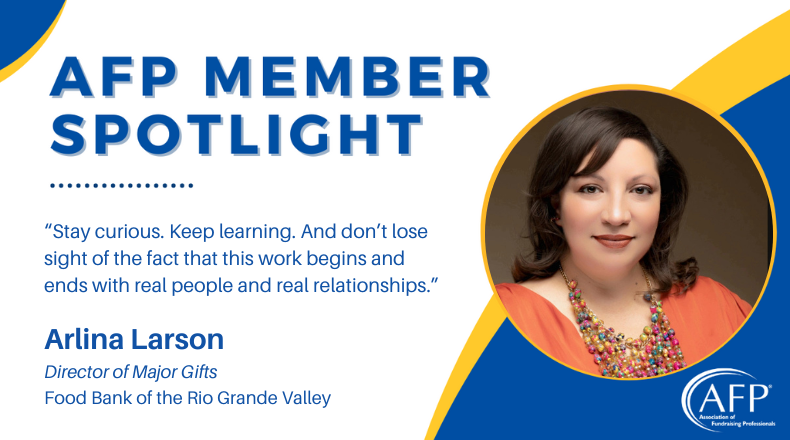
In this member spotlight, we interviewed Arlina Larson, director of major gifts at the Food Bank of the Rio Grande Valley. After a dynamic career in business, events, and design, Arlina discovered that every twist in her journey—from childhood school raffles to leading high-stakes campaigns—uniquely prepared her for a mission-driven role in philanthropy. Now, she’s fostering a culture of collaboration, celebrating generosity, and proving that investing in people is the most innovative strategy of all.
Q: How did you start your career in the fundraising profession and what led you there?
A: If someone had told me twenty years ago that I’d be leading development strategy, building fundraising campaigns, and working to fight food insecurity—I wouldn’t have seen it coming. Fundraising wasn’t even on my radar. At the time, I was focused on building a career in business. I had big goals and a clear vision of success, which included being retired and traveling the world by now.
But over time, my priorities shifted. Every turn in my career—whether planned or unexpected—taught me something valuable and gave me tools I didn’t even know I’d need. Now, I’m in a role where it all comes together. Strategy, creativity, leadership, problem-solving—every skill I’ve developed over the years is being put to use. I can’t think of another job where every part of my experience feels this relevant, this necessary, and this rewarding.
Looking back, my first real experience with fundraising was in elementary school. I attended a small private school where raffle tickets, in-kind donations, and sponsor asks were just part of the culture. My parents would point to someone—a friend, a local business owner—and say, “Go ask.” So, I did. I didn’t realize it at the time, but those early moments taught me how to advocate for something, how to connect with people, and how to represent a cause with confidence—even when I wasn’t entirely sure what I was doing.
Fast forward twenty years, and I had built a career in the private sector—working in customer service, sales, marketing, and eventually interior design. At the time, it felt like a natural progression. But in hindsight, I was developing the exact skills I now use every day: communication, creative strategy, leadership, and the ability to adapt in fast-paced environments.
That path eventually led me to a 13-year role as general manager of a busy event venue, where I wore every hat—designer, negotiator, project manager, and team leader. Around that same time, my son started attending the same small school I had. Life came full circle when I became chair of their annual fundraiser. What once was a school tradition had become a critical campaign, raising $150,000 to $200,000 each year. I didn’t realize it then, but I was learning how to lead volunteer teams, secure sponsorships, and navigate the many moving pieces of a fundraising campaign.
Then came 2020. COVID shut down the event industry, and I took a step back to focus on my family. I also enrolled in psychology courses to better support my son, who lives with generalized anxiety disorder. What I didn’t expect was how much those courses would influence my professional life. They helped me better understand people—how to listen, how to build trust, how to recognize when someone’s ready to say yes. In a lot of ways, they made me a stronger fundraiser.
Eventually, I started thinking about what might come next—but I wasn’t in any rush to return to work. I had planned on staying out of it for a while longer. Then, while on vacation, I got a call from a board member at Palm Valley Animal Society. They needed help with events and offered me a position as an event coordinator. It was an entry-level role, and after managing a large event venue for 13 years, I figured it would be a light lift. Easy enough.
That’s the part nonprofit professionals laugh at—because nothing about nonprofit work is easy.
The resources are lean, the learning curve is steep, and the stakes feel personal. I had to get up to speed fast—not just on logistics, but on the mission. At nonprofit events, you're not just managing run-of-show—you’re often the face of the organization, answering questions and sharing impact on the fly. It’s a whole different world, with its own language, pace, and culture. And I was hooked.
Within five months, I was promoted to director of development, overseeing all things fundraising and marketing. Every skill I’d picked up over the years—from business and design to psychology and leadership—finally had a home in this mission-driven space.
Now, I’ve found my home at the Food Bank of the Rio Grande Valley. Every campaign, every donor relationship, every act of generosity feeds into something larger than any one of us. I didn’t plan on becoming a fundraiser—but everything in my path prepared me for this work. And I’m exactly where I’m meant to be.
Q: When and why did you decide to become an AFP member?
A: I had just started my position at the Food Bank RGV and was meeting with a fundraising consultant who casually mentioned AFP, assuming I knew what it was. I nodded along, took notes, and after the call, I immediately looked it up. What started as a quick search turned into hours of reading. I was blown away by the sheer volume of resources available. It felt like I had unlocked a whole new world of support for fundraisers.
Unfortunately, there’s no local chapter near me. I live in the southernmost part of Texas, right on the U.S.-Mexico border. It took some convincing—of myself and my supervisors—to join a chapter that wasn’t exactly close. The nearest one, AFP Coastal Bend, is about two hours away in Corpus Christi. But joining that chapter was one of the best decisions I’ve made.
The leaders of AFP Coastal Bend were incredibly welcoming. Despite the distance, they made me feel connected and supported from day one. Since then, I’ve had the opportunity to attend both AFP LEAD and AFP ICON—two of the most impactful professional experiences I’ve had. The knowledge, the community, and the friendships I’ve gained have been invaluable.
Q: Are you doing anything innovative at your organization (or a past organization) that you think other fundraisers could benefit from?
A: It may not sound flashy, but one of the most innovative things we’re doing at the Food Bank RGV is investing time—real, protected time—into leadership and team development. Most nonprofits are so deep in the weeds that training becomes an afterthought. There's this unspoken “sink or swim” mentality. But I’ve made it a priority to change that.
We hold weekly sessions with the full development and marketing team, along with one-on-one check-ins with each manager. Every other month, we bring in a fundraising consultant to help us stay sharp. Internally, we’ve done everything from presentation and communication skills to personality assessments and role-based reflections. We talk about where we see ourselves growing, how our skills fit together, and how we show up—for our donors and for each other.
I pull a lot from what I learned in the private sector, and from what I continue to learn through AFP, mentors, and peer fundraisers. We’re working on getting better at communication, building authentic donor relationships, and understanding that fundraising is a team effort. Not just for major gift officers or event planners—everyone.
Since implementing this, I’ve seen major shifts. Tasks are becoming more streamlined. Collaboration is improving. And people are beginning to see themselves as part of something bigger than their job description. When I first arrived, there were people in the department who had barely spoken to one another. That was wild to me. We’re all working toward the same mission—why not work together to get there faster?
We’re busy, like every nonprofit team. But we’ve made it a habit to protect time for growth. If another fundraiser asked me how to start, I’d say: just block off an hour a week. Meet with your team as a whole and individually. That space builds confidence, encourages collaboration, and helps share the burden.
It’s not always easy—but it’s worth it.
Q: What is your favorite word? How has this word influenced or inspired your career?
A: My favorite word is revelry.
I come from a big, colorful, loud family where we celebrate everything. We celebrate with music, food, and yes, sometimes a good tequila. It’s just part of who we are. That energy—the joy, the connection, the gathering of people—is something I’ve carried with me into my professional life.
Before I stepped into the nonprofit world, I spent years helping others plan meaningful moments.
Celebration became second nature.
Now, as a development professional, I’ve woven that spirit into how I lead. I believe fundraising should feel like a kind of revelry—a celebration of generosity, community, and shared purpose. I celebrate my team’s wins, our donors’ impact, and our supporters’ dedication. We don’t wait for the big milestones. We find joy in the process, in the collaboration, and in the progress we make together.
Revelry reminds me that this work—while serious in mission—can still be full of life. Because when people feel seen, appreciated, and connected, they don’t just give. They come back, they bring others, and they stay.
Q: What professional accomplishment are you most proud of?
A: Honestly, I’m most proud of the growth I’ve made in a relatively short time. I started in the nonprofit world as an event coordinator, and within five months, I was promoted to director of development. In my current role, I was originally brought in as director of major gifts, but was soon asked to step into the broader role of development director. To be seen—and trusted—in those moments meant everything.
I’ve led campaigns, closed meaningful gifts, and launched programs I’m proud of. But what matters most to me is how much I’ve learned, grown, and contributed in the past four years. It’s gone by in a blink and felt like a lifetime at the same time.
I’ve taken advantage of every opportunity to grow, to lead, and to teach—whether through AFP conferences, mentorships, or just showing up fully for my team. The fact that I get to use the skills I’ve gathered over a 20-year career and see them make a difference every day? That’s the real accomplishment.
Q: How has being an AFP member and participating in the AFP affinity groups benefited you in your career?
A: Becoming an AFP member has been a game-changer in my career. I took the Certificate in Nonprofit Management course through AFP, and the amount of practical, thoughtful, and well-organized information available was honestly life-changing. It helped me make sense of so much I was experiencing as a relatively new fundraiser—and it gave me the confidence to lead more effectively.
Being part of an AFP affinity group has added another layer of connection and support. There’s something powerful about being in a space where people from all over the country—different roles, different missions—can come together and immediately understand each other. It gives me a sense of shared purpose and a reminder that, even when the work feels heavy, I’m not doing it alone.
Q: In your opinion, what is the biggest challenge facing the nonprofit fundraising profession today?
A: Misconception. That one word touches so many of the challenges we face. There’s a misconception about what nonprofits actually do—what it takes to run programs, build infrastructure, and serve communities with dignity. There’s also a misconception about fundraising itself—that it’s just “asking for money,” instead of what it really is: relationship-building, strategy, storytelling, and stewardship.
Internally, fundraisers are often expected to simply “go get the money,” without always having the tools, context, or support to do that well. And externally, donors and even board members sometimes don’t see the full picture of what it takes behind the scenes to make impact happen.
Clearing up those misconceptions takes time, education, and consistency. But it’s essential. Because when people understand the value of fundraising—and the true role of fundraisers—they don’t just support the mission. They invest in the people making it possible.
Q: What advice do you have for other fundraising professionals?
A: Never stop learning—and learn how to listen.
Fundraising isn’t just about asking. It’s about building real relationships. I often compare it to dating: you wouldn’t meet someone once and immediately propose. You take time to learn what matters to them, how they communicate, and what kind of relationship they’re open to.
Whether it’s someone giving time, money, or attention, they want to feel known and valued. The individuals behind every gift deserve the same level of thought and care.
And this doesn’t just apply to donors—it applies to your team too. Everyone brings their own pace, their own language, their own way of showing up. The more we invest in understanding each other, the stronger our work becomes.
So stay curious. Keep learning. And don’t lose sight of the fact that this work begins and ends with real people and real relationships.
Read More