AFP Member Spotlight: Aaron Dill




AFP Member Spotlights are a recurring series of interviews with AFP members, highlighting the unique individuals and career paths that exist within the fundraising profession. If you know an inspiring fundraising professional who deserves to be featured, please email [email protected].
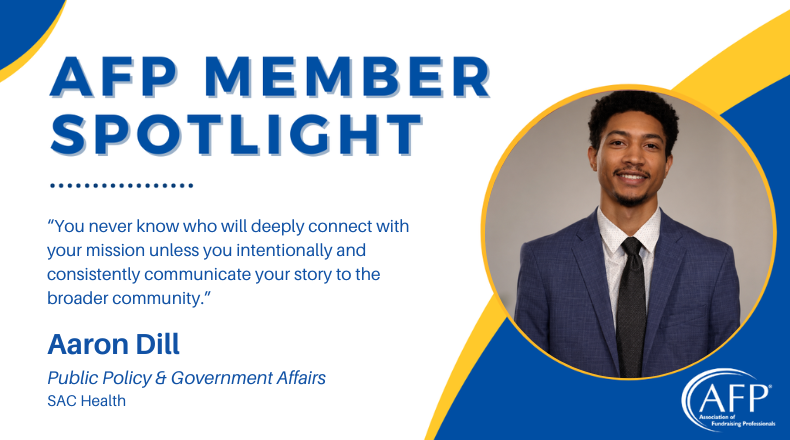
In this member spotlight, we interviewed Aaron Dill, public policy & government affairs at SAC Health. His journey from public service into philanthropy has been guided by a focus on trust, equity, and growth, with a clear emphasis on strengthening relationships and systems that support long-term impact. Aaron’s perspective highlights why collaboration and sustainability are essential to the future of fundraising.
Q: How did you start your career in the fundraising profession and what led you there?
A: As a long-time state employee, my path into fundraising developed through relationship-building, strategy, and advocacy work. Early in my career, I served as a program manager for a state-led initiative called California Jobs First, a regionally focused, cross-sector investment initiative that brought together public and private stakeholders to develop strategies supporting community-serving projects and workforce development efforts aimed at driving inclusive economic growth across Inland Southern California. Through that experience, I saw firsthand how strong community trust, strategic partnerships, and intentional systems-building can strengthen an organization’s long-term sustainability and impact.
Since that role, I’ve joined the SAC Health, where my work has become more directly focused on development and philanthropy strategy. Through this work, I’ve become increasingly interested in how organizations build lasting donor relationships, create sustainable fundraising infrastructure, and align fundraising efforts with broader organizational goals and community impact. I view fundraising as much more than securing resources. It is about building trust, cultivating long-term relationships, and helping organizations position themselves for sustainable growth and a lasting impact.
Q: When and why did you decide to become an AFP member?
A: I was invited to an AFP Inland Empire Chapter event by my fellow IE board member, Krystle Joseph. I joined AFP because I believe fundraising is both a profession and a responsibility that requires ethical leadership and strong peer networks. As my work in development strategy and philanthropy expanded, I wanted to be connected to a community of professionals who are thoughtful about the future of fundraising and committed to best practices.
AFP provides an important space for collaboration, professional development, and conversations about how the field continues to evolve. Being part of that community has helped strengthen both my perspective and my leadership.
Q: Are you doing anything innovative at your organization (or a past organization) that you think other fundraisers could benefit from?
A: I’ve worked on initiatives that improve donor engagement journeys, strengthen collaboration across departments, and better integrate communications, branding, community engagement, and development strategy.
At SAC Health, one of our primary goals during this capacity-building process is helping organizations move beyond short-term fundraising goals and instead focus on long-term relationship-building, donor retention, and sustainable pipeline development.
I also believe organizations benefit greatly when they invest in systems, data-informed decision-making, and stronger alignment between mission and fundraising strategy.
To me, innovation in fundraising is not simply about adopting new tools or platforms. It’s about being adaptable, understanding how the philanthropic and community landscape continues to evolve, and building systems that support meaningful and lasting engagement.
Q: What is your favorite word? How has this word influenced or inspired your career?
A: Community
Community-centered engagement has shaped the way I approach both fundraising and organizational leadership. As all things are, the nonprofit sector is constantly changing.
Keeping the wellbeing of the community at the center of the work has pushed me to continuously evaluate systems, ask deeper questions, and identify opportunities to strengthen organizational support and long-term sustainability. I strongly believe the most impactful fundraising strategies are grounded in authentic relationships, grassroots engagement, and genuine human connection.
Q: What professional accomplishment are you most proud of?
A: While this accomplishment falls outside of fundraising directly, one of my proudest professional achievements was helping support the passage of Ethnic Studies in the California Legislature while serving as a field representative for then-assemblymember, now Riverside County supervisor, Jose Medina.
Ethnic Studies is an interdisciplinary field that critically examines the histories, cultures, and systemic experiences of historically marginalized racial and ethnic communities. The legislation highlighted the importance of African American, Asian American, Latinx/Chicanx, and Native American studies within education.
As a person of color, I viewed this as an important opportunity to help ensure more communities could see themselves reflected in the broader story of American history. Too often, these perspectives and experiences are minimized or excluded from larger conversations about our country’s history and identity. Being part of that effort remains deeply meaningful to me.
Q: How has being an AFP member and participating in AFP affinity groups benefited you in your career?
A: AFP has reinforced the importance of networking and community within the fundraising profession. The affinity group sessions in particular, create space for meaningful conversations around leadership, sustainability, professional growth, and navigating the evolving challenges within our field. Those connections have helped sharpen my perspective and reminded me that fundraising is collaborative work grounded in shared purpose, ethical storytelling, and collective impact.
Q: In your opinion, what is the biggest challenge facing the nonprofit fundraising profession today?
A: Sustainability is one of the biggest challenges facing the nonprofit sector today. As organizations respond to rapid changes within the political, economic, and social landscape, many nonprofits are being asked to do more with less.
At the same time, fundraisers often operate in environments driven by constant urgency and high expectations, which can lead to burnout. Sustainable fundraising requires organizations to invest in long-term strategy, realistic goals, strong infrastructure, and healthy organizational cultures that value relationship-building just as much as revenue outcomes.
Q: What advice do you have for other fundraising professionals?
A: Focus on building and maintaining long-term relationships and developing sustainable strategies. Don’t allow someone’s title or organization to deter you from having a conversation. The worst thing that can happen is not someone telling you “no.” The worst thing that can happen is not giving yourself the opportunity to connect with someone on a human level. There is far more that connects us than divides us. Collaborate across internal departments and across sectors externally. You never know who will absolutely love your mission if you don’t do the work to communicate your message broadly.
You never know who will deeply connect with your mission unless you intentionally and consistently communicate your story to the broader community.

Read More