Giving USA 2026: What Fundraisers Need to Know for Year-End



As nonprofits head into the 2026 year-end giving season, they are planning within an environment shaped by ongoing change, making reliable data more important than ever for shaping fundraising strategy. Giving USA 2026: The Annual Report on Philanthropy for the Year 2025 offers insight into what drove results in 2025 and where opportunities may continue into 2026.
What the 2025 Data Shows
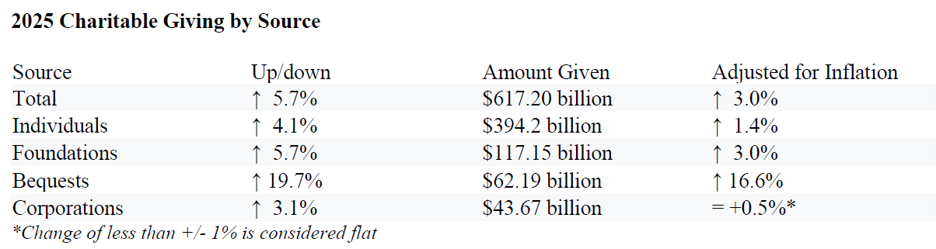
Total U.S. charitable giving reached an estimated $617.20 billion in 2025 — surpassing the $600 billion mark for the first time in history. That represents a 5.7% increase in current dollars, or 3.0% when adjusted for inflation. It is the second-highest total on record in real terms, and a meaningful signal of the sector’s resilience in the face of economic uncertainty.
The headline growth was powered by a few standout trends:
- Bequest giving surged 19.7% (16.6% adjusted for inflation) to $62.19 billion — the strongest growth of any source. Bequests have now risen 20% or more in current dollars in three of the last four years, a sustained shift that reflects growing estate values and, importantly, the long-term relationship cultivation work that fundraisers have invested in over the past decade.
- Foundation giving grew 5.7% (3.0% adjusted) to $117.15 billion, surpassing $100 billion for the third straight year.
- Individual giving — nearly two-thirds of all charitable giving — grew 4.1%, but only 1.4% after adjusting for inflation. This modest real-dollar gain reflects a persistent tension: financial markets were strong, but consumer sentiment remained near historic lows, with many households continuing to feel economic pressure.
- Corporate giving grew just 3.1% (essentially flat in real terms), though it has expanded 60% over five years, outpacing total giving growth of 29% over the same period.
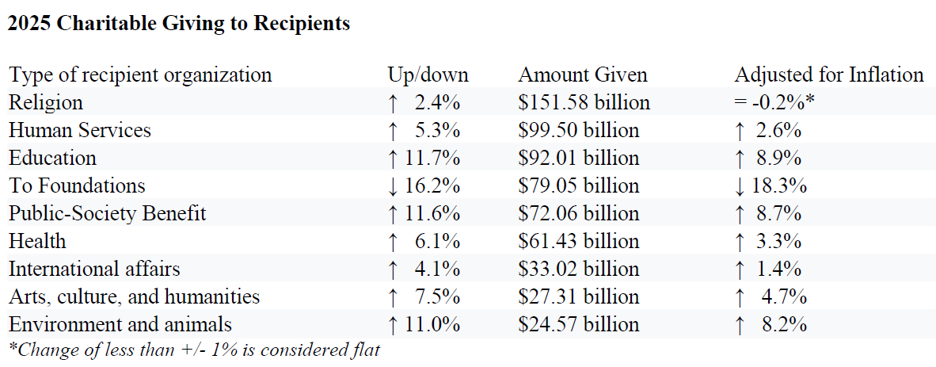
On the recipient side, eight of nine subsectors grew in current dollars, with education (↑ 11.7%), public-society benefit (↑ 11.6%), and environment and animals (↑ 11.0%) seeing the most significant gains. Human services, health, and arts/culture/humanities all also saw modest growth. Religion — still the largest category at $151.58 billion — was essentially flat after inflation (-0.2%). Giving to foundations as recipients declined 16.2% following a record 2024 high, but remains among the highest years on record.
The Context for Fundraisers
The Giving USA results are supported by the Q4 2025 Fundraising Effectiveness Project (FEP) report, released in April, which put total growth in giving at 5% for 2025 — the highest rate in five years. Both reports highlight the overall resilience of the giving environment, yet both also contain additional metrics that paint a more nuanced picture.
In the FEP findings, the continued dependence on major and supersize donors, coupled with the shrinking donor base, indicates that participation in charitable giving is not distributed evenly across households and income levels. This is echoed in the Giving USA report with the modest gains in individual giving and the low consumer sentiment.
For fundraisers, this means translating these patterns into clear priorities as they plan for the 2026 year-end giving season.
1. Lean Into Planned Giving
The sustained surge in bequest giving is one of the clearest signals in the 2025 Giving USA report. Three of the last four years have seen 20% or more growth in bequest giving in current dollars. This pattern over multiple years reflects more than short-term variation, highlighting the impact of long-term relationship cultivation and planned giving efforts.
Rising asset values mean donors may be in a stronger position than ever to make a transformational planned gift. If your organization does not have a legacy giving program, there has never been a clearer data-driven case for starting one. If you do, year-end is an ideal moment to incorporate it into your outreach, particularly with donors who have given consistently for five or more years and have never been asked about their long-term intentions.
2. Expand Your Giving Channels — Especially DAFs and QCDs
The Giving USA data shows public-society benefit organizations — a category that includes national donor-advised fund (DAF) sponsors like Fidelity Charitable and Vanguard Charitable — grew 11.6%, one of the fastest-growing subsectors. According to the 2025 Annual DAF Report, DAF assets have nearly doubled since 2020, reaching $326.45 billion in 2024, while the number of accounts has grown to more than 3.56 million. DAFs now represent a significant share of charitable giving, with an estimated 15.1% of all contributions directed to these vehicles and nearly a quarter of individual giving flowing through them.
For fundraisers, this signals both scale and opportunity. Ensuring your organization is well positioned to receive and encourage these gifts is critical heading into year-end.
With tax changes from the One Big Beautiful Bill now taking effect in 2026, qualified charitable distributions (QCDs) from IRAs are also becoming increasingly valuable for senior donors. Make sure your website makes it easy to give through both of these channels — at minimum, include clear information about how to make a DAF grant or QCD to your organization. Better yet, add a DAF widget to your donation page and have direct conversations with your donors about the tax advantages available to them this year.
3. Strengthen and Rethink Your Foundation Strategy
Foundation giving reached $117.15 billion in 2025, growing 5.7% in current dollars and surpassing $100 billion for the third consecutive year. This sustained level of giving reflects continued grantmaking capacity and points to a growing opportunity for organizations prepared to engage institutional funders.
At the same time, shifts in public funding and broader sector pressures are changing how many organizations approach this work. Increasingly, funders are looking not only at individual programs, but at collaboration, scale, and shared impact across communities.
For fundraisers, this moment presents an opportunity to think beyond traditional grant-seeking approaches. Partnering with other nonprofits, whether through shared proposals, aligned programming, or coalition-based initiatives, can strengthen your case for funding and demonstrate a broader understanding of the communities you serve. In a funding landscape shaped by both opportunity and constraint, collaboration can help organizations access new resources while building the kind of collective strength that funders are increasingly prioritizing.
4. Build Resilience Through Diversification
The 2025 Giving USA results are encouraging, but they also reinforce the importance of building a more balanced funding approach. Organizations positioned to receive bequest gifts, foundation grants, and DAF distributions likely saw stronger gains in 2025, while those relying primarily on small individual gifts faced a more modest environment.
For fundraisers, this underscores the need to evaluate where revenue is concentrated and where there may be gaps. Diversification can take many forms, from expanding planned giving and foundation outreach to strengthening corporate partnerships or exploring new giving channels. The most effective strategies will be grounded in your own data — who is giving, how they give, and where there is room to grow.
The organizations best positioned for long-term stability are those building a mix of revenue streams that can adapt to changing conditions, rather than relying too heavily on any single source.

Read More