
A Juneteenth Reflection on Mentorship, Philanthropy, and AFP's Affinity Groups



For me, Juneteenth has always represented more than a moment in history — it represents possibility.
As an African American fundraiser, nonprofit leader, and advocate for our profession, I often reflect on the generations of Black leaders, educators, artists, entrepreneurs, and philanthropists who invested in their communities long before they had access to the resources or recognition they deserved. Their commitment to collective progress created opportunities that many of us benefit from today.
Growing up in Dayton, Ohio, I witnessed the power of community firsthand. I saw how local organizations, mentors, and community leaders could change the trajectory of someone's life. Those experiences ultimately shaped my career in fundraising and reinforced a belief that continues to guide my work today: philanthropy is not simply about raising money — it is about creating opportunities.
That perspective feels especially relevant as we reflect on Juneteenth. While Juneteenth commemorates the day in 1865 when enslaved African Americans in Texas finally learned of their freedom, it also serves as a reminder of resilience, hope, and the ongoing pursuit of equity and opportunity. It is a celebration of progress, but also a call to continue investing in stronger, more diverse and inclusive communities.
As fundraising professionals, we spend much of our time helping others realize their vision for a better future. We connect generosity with impact, build bridges between communities and causes, and help organizations fulfill their missions. As Black fundraising professionals, this work often carries an additional layer of meaning because we understand the transformative power of investing in all people and communities.
Throughout history, Black communities have embraced philanthropy, often without calling it by that name. Long before formal philanthropic institutions recognized our contributions, Black churches, mutual aid societies, neighborhood organizations, and families practiced collective giving and community care. We have always understood that when one person succeeds, the entire community benefits.
Today, fundraising professionals continue that tradition. Whether supporting arts organizations, educational institutions, healthcare systems, social justice initiatives, or community development efforts, we help connect resources to opportunities that improve lives.
Over the past decade, I have had the privilege of serving organizations focused on the arts and social justice. My work has also reinforced another important lesson: successful fundraising is about far more than dollars raised. It is about relationships.
The most impactful fundraisers are not simply skilled solicitors. They are listeners. They seek to understand what inspires people, what they care about, and how they want to make a difference in the world. At its core, philanthropy is an expression of hope, concern and care—a belief that together we can create a better world for all humankind.
Along my own journey, I have been fortunate to learn from mentors, colleagues, and leaders who opened doors, shared wisdom, and challenged me to grow. Their guidance has shaped not only my career but also my understanding of leadership.
That is why mentorship remains one of the most important investments we can make in our profession.
For many African American fundraising professionals, finding mentors and building professional networks can be transformational. Representation matters. Seeing leaders who share similar experiences helps emerging professionals envision what is possible for themselves. Mentorship creates confidence, accelerates learning, and reminds us that we do not have to navigate our careers alone.
Equally important is creating safe spaces where professionals feel a true sense of belonging.
Affinity groups play a critical role in fostering those connections. They provide opportunities to share experiences, celebrate accomplishments, exchange ideas, and discuss challenges with peers who understand the unique perspectives we bring to this work. These communities strengthen individual careers, the fundraising profession and the entire philanthropic ecosystem.
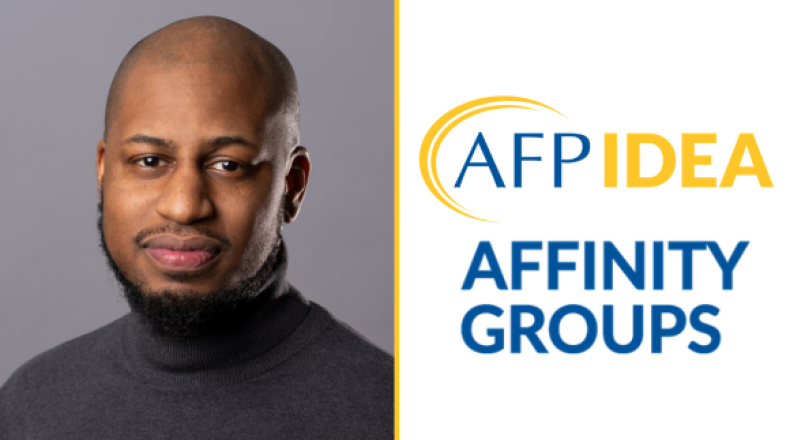
As I step into leadership of the African American/Black Affinity Group, my vision is simple: I want every Black fundraising professional to know they belong in this profession and have a pathway to thrive within it.
I want our affinity group to be a place where we promote fundraising as a viable profession, where emerging professionals find mentors, where experienced leaders share their knowledge, and where meaningful relationships are built. I envision a community that supports professional development, encourages leadership, celebrates achievement, and amplifies the voices of African American fundraisers across the sector.
Most importantly, I hope we continue to create opportunities for connection. Fundraising can sometimes feel isolating, but none of us succeeds alone. We grow through relationships, shared experiences, and a willingness to invest in one another.
The future of philanthropy depends on our ability to build inclusive communities where every professional feels empowered to contribute their talents and perspectives. As we reflect on the significance of Juneteenth and the legacy of those who came before us, we are reminded that meaningful progress is achieved when all people are invited to come together around a shared purpose.
That spirit of community, resilience, and collective impact continues to guide my work today. It is the foundation upon which I hope to help build the future of the African American/Black Affinity Group, and it is the reason I remain optimistic about what lies ahead—for our profession, our communities, and the generations that will follow.
Join us for our next meeting of the African American/Black Affinity Group tomorrow, June 26 at 1 p.m. ET.

Read More