AFP Member Spotlight: Gabriela Ott




AFP Member Spotlights are a recurring series of interviews with AFP members, highlighting the unique individuals and career paths that exist within the fundraising profession. If you know an inspiring fundraising professional who deserves to be featured, please email [email protected].
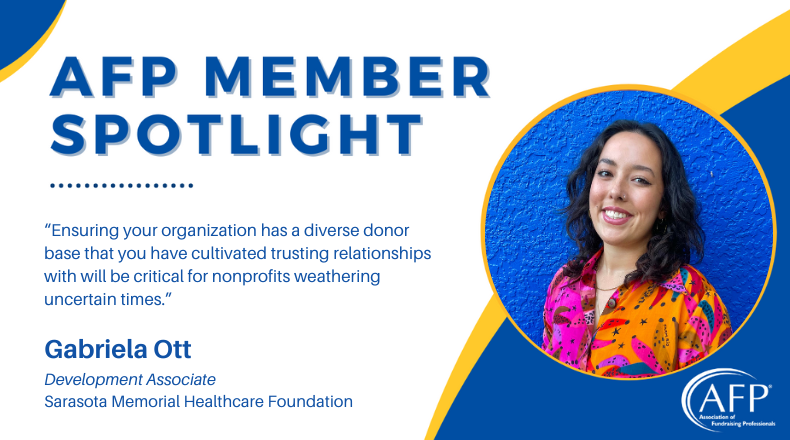
In this member spotlight, we interviewed Gabriela Ott, development associate at the Sarasota Memorial Healthcare Foundation. Here she is blending her past experience in higher education, with a new career in fundraising. In just one year, she has embraced AFP's resources, led heartfelt donor stewardship efforts, and advocates for authentic, relationship-driven philanthropy rooted in resilience and connection.
Q: How did you start your career in the fundraising profession and what led you there?
A: I am about to reach my 1-year anniversary in fundraising, and I am truly enjoying every minute of my new field. I had previously worked in higher education, specifically student activities, and knew I had a passion for giving back to my community. While I love working with students and creating educational spaces, I wanted to explore the opportunity to make changes through philanthropy. I was nervous to make the leap and start over as a beginner, but I’m now working at the Sarasota Memorial Healthcare Foundation (SMHF) and supporting the life-changing efforts of the hospital system has been deeply impactful. I am proud of the chance I took and the ways I have been able to blend my past work experience into my new field and skills.
Q: When and why did you decide to become an AFP member?
A: As a lifetime learner I am always on the lookout for opportunities to grow my abilities. When I started working at SMHF, the development team and our president, Stacey Corley, heavily encouraged me to join AFP for the tremendous professional development and educational resources it offers. The support from leadership and regular team attendance at AFP events engrained in our organization the importance of continued growth which made joining an easy decision!
Q: Are you doing anything innovative at your organization (or a past organization) that you think other fundraisers could benefit from?
A: I believe expressing your gratitude to donors is a fundamental part of the fundraising cycle. Data shows the psychological impact a meaningful thanks can have on donor engagement, retention, and future giving. At SMHF, I conduct personal thank-you calls for our donors who do not already have an established relationship with our team. I get weekly lists and take the time to review their records, giving history, and information to make a thank-you call that is genuine to our donors. I take the time to truly listen to grateful patients’ stories, answer questions, and take notes for future pipeline placements. While not all organizations may have the time or staffing to devote to our personalized approach, I cannot encourage it more as it has had tremendous positive effects on donor experience.
Q: What is your favorite word? (only one word) How has this word influenced or inspired your career?
A: Resilience. It is not an easy time to be a young professional. From global pandemics, an unpredictable economy, the uprooting of entire industries, and bleak job markets— it can feel like every time you try to take a step forward life pushes you back. COVID wiped out years of my academic and professional plans. While working in higher education I watched as my college was uprooted by political divisiveness. I had to weigh the pressure of beginning a new career trajectory with the mounting costs of living. Working in fundraising reminded me how important resiliency is as it can be the difference between allowing adversity to obstruct your goals or forging your own success. My resilience and ability to persevere through difficulties has led me to every promotion, job offer, and career milestone.
Q: What professional accomplishment are you most proud of?
A: Reflecting on my fundraising career thus far, I am extremely proud of my first major gift interaction. I was speaking with someone who had never donated to SMHF but whose loved ones had positive experiences at the hospital prior to their passing. As we spoke, they began to share their grateful patient story and about their family members who passed. The conversation stopped being about “fundraising” or “donor discovery” and was just a meaningful human interaction. Being reminded of the way healthcare changes people’s whole world and seeing how much SMHF meant to this donor was truly touching. We discussed some questions about funding areas, and they decided to make a significant donation. It was my first major gift, but what brought me the most pride was the genuine conversation and relationship made. Sometimes when walking through the hospital, or calling a family member, a piece of what they shared will pop into my head, and I am reminded of their story and how proud I am to have been there to support them.
Q: How has being an AFP member and participating in the AFP affinity groups benefited you in your career?
A: My time in the Latinx affinity group and the SWFL DEI committee have been truly meaningful for me. It can be intimidating to be a young, Latina professional navigating a new field and AFP has given me the invaluable avenue to find community who understand my experiences. Having the chance to connect with members who share my culture, history, and passions creates a true sense of community that bridges across organizations and state lines. Exploring the intersection of identity and fundraising with other members also gives industry insights you can’t readily find elsewhere as they flow from organic group discussions. I am grateful for the confidence and kinship these spaces have given me and cannot recommend participating strongly enough!
Q: In your opinion, what is the biggest challenge facing the nonprofit fundraising profession today?
A: I find myself repeatedly reminded that philanthropy does not happen in a vacuum. Now more than ever in times of heightened political tension, economic anxiety, and social isolation it is critical for fundraisers to develop deep interpersonal connections with donors of all levels. Ensuring your organization has a diverse donor base that you have cultivated trusting relationships with will be critical for nonprofits weathering uncertain times.
Q: What advice do you have for other fundraising professionals?
A: Lead with your heart. As someone who is relatively new to this field, I have found that my moments of great pride and success have come from when I led with enthusiastic honesty. From taking a moment to be truly present when a donor is reliving their healthcare experience, to relaxing a conversation with a personal anecdote— removing layers of inauthentic coldness that we have been taught makes us appear “professional” have resulted in new prospects and meaningful gifts. A good fundraiser can bring in a check, but a great fundraiser brings in donor trust. Lead with your heart and the funds will follow!

Read More