AFP Member Spotlight: Gretchen Norton, MNO




AFP Member Spotlights are a recurring series of interviews with AFP members, highlighting the unique individuals and career paths that exist within the fundraising profession. If you know an inspiring fundraising professional who deserves to be featured, please email [email protected].
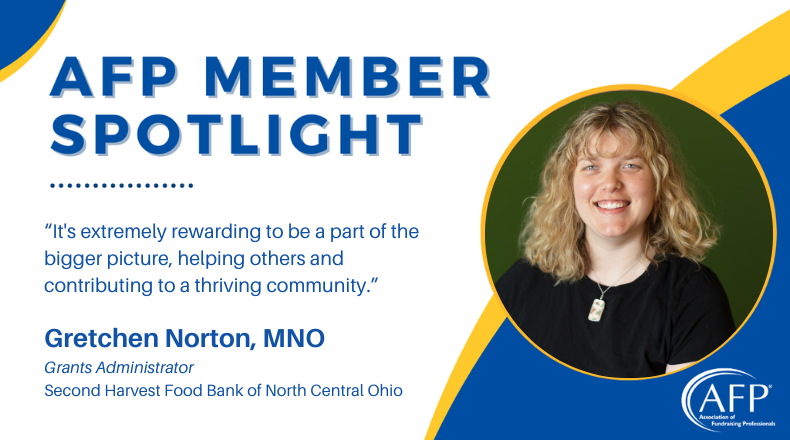
In this member spotlight, we interviewed Gretchen Norton, MNO, grants administrator at Second Harvest Food Bank of North Central Ohio. She shared with us how her philanthropic family taught her from an early age the essential skills, such as engaging with boards, conducting site visits, and writing grants, that she would eventually carry with her into her future career in nonprofits.
Q: How did you start your career in the fundraising profession and what led you there?
A: Philanthropy is in my blood. I’m privileged to come from a deeply philanthropic family—my great-grandmother founded The Stocker Foundation in 1979, where I now serve proudly as a fourth-generation board member, and my grandfather established The Norton Family Foundation. On top of that, my grandparents and parents are very active in their local community and are community leaders in their own right.
From a young age, my family taught me and my siblings the importance of giving back to our community. This was reinforced at the K-12 school I attended, Lake Ridge Academy, which would compete in “coin wars” and “can wars” every winter. All of the donations went to the local church food pantry, which provided essential support to families in need.
I became further immersed in the world of nonprofits, serving on The Stocker Foundation Junior Board, where I learned how to understand board operations, navigate the grant review process, and conduct site visits. My very first site visit was at age nine, alongside my grandmother, who guided me through setting up a meeting and asking thoughtful questions. By fifteen, I had written my first grant: the executive director of Save Our Children, a family friend who knew both my background and my writing skills, entrusted me to craft a proposal for a boys’ program they were developing. A few months later, she shared the exciting news—they received full funding. From that moment on, I was hooked and realized that grant writing could be a career path for me.
I originally planned to get an English degree when I went to Allegheny College, but my Intro to Community and Justice Studies class made me fall even more in love with mission-oriented work, so I decided to change my major to Community and Justice Studies. It was a holistic degree covering racial studies, political science, and communications. To complement that focus, I minored in both English and Political Science. Since I graduated during COVID-19, I went right into getting a Master's in Nonprofit Organization at Case Western Reserve University-Mandel School of Applied Social Sciences.
Since then, I've worked exclusively in nonprofits throughout Northeast Ohio, largely in the development departments. The food bank sector has been my true love, and I've happily been the grants administrator at Second Harvest Food Bank of North Central Ohio for a year and a half.
Q: When and why did you decide to become an AFP member?
A: I was encouraged to join AFP in 2022 by Jessica Malone, the secretary of the AFP Greater Cleveland Chapter; however, I was at a point in my life where I didn't feel ready to commit. That encouragement stayed in the back of my mind for two years. When I became Grants Administrator, I realized I wanted to become more connected with the fundraising and grant writing community and formally joined AFP in 2024.
Q: Are you doing anything innovative at your organization (or a past organization) that you think other fundraisers could benefit from?
A: I've been working on strengthening my relationships with foundations. Second Harvest Food Bank of North Central Ohio covers a four-county service area, and we have a 130+ partner charities. Despite this broad reach, much of the community, as well as foundations, particularly in the more rural areas, aren’t aware of our scope, so we’ve been conducting brand awareness campaigns.
To assist with this initiative, I've been conducting meetings with foundations who provide funding, but haven't visited our facility either in years or at all. With this, I've been able to better discuss our programs and visually show them how state and federal cuts have greatly affected us.
Additionally, I've been working on cases for support for our strategic initiatives, so at an organizational level, we are using the same language in our grant applications as we do when we discuss our programs with volunteers and neighbors.
Q: What is your favorite word? (only one word) How has this word influenced or inspired your career?
A: What kept coming to me wasn't a word, but a phrase, "If you continually give, you continually have." This phrase has been the driving force behind my grandparents’ philanthropy, and it's the driving force behind my work. I see it not as just giving treasure to organizations that speak to me but also giving my time and talent both professionally and personally. It's extremely rewarding to be a part of the bigger picture, helping others and contributing to a thriving community.
Q: What professional accomplishment are you most proud of?
A: I see every grant awarded as a professional accomplishment; however, I did recently receive notification that the largest grant of my career (so far) has been approved. I got a shoutout in our August team meeting for it.
Q: How has being an AFP member and participating in the AFP affinity groups benefited you in your career?
A: Being an AFP member has helped me build relationships with other grant writers and organizations in the area. I've made several connections with people who are interested in volunteering with our food bank. Joining the Young Professionals affinity group has introduced me to so many amazing people! It's nice to talk to others who are having the same experience navigating the workplace, when sometimes we're the youngest people in the room. I always feel reinvigorated after these meetings.
Q: In your opinion, what is the biggest challenge facing the nonprofit fundraising profession today?
A: Lately, as federal resources are being reduced or completely terminated, it can be easy to fall into a competitive mindset. Foundations have the same amount of funds to distribute, but more organizations are making requests. Meanwhile, some individual donors are scaling back their donations due to their personal budget constraints. However, a mission cannot advance, and communities won't be served with the highest standard of care, if we succumb to this line of thinking based on scarcity and competition. This is the time to come together and think outside the box for solutions.
Q: What advice do you have for other fundraising professionals?
- Collaborate—with your coworkers, community members, and other organizations. You never know where your next, best idea will come from; sometimes you don't know your own talents until someone asks for your assistance.
- Work-life balance—I'm a massive believer in a healthy balance, and no one performs their best work if it's off-kilter. Fundraising emergencies are rare, and if one does occur, your coworkers will know how to get ahold of you.

Read More