AFP Member Spotlight: Jennifer Kelley Killian




AFP Member Spotlights are a recurring series of interviews with AFP members, highlighting the unique individuals and career paths that exist within the fundraising profession. If you know an inspiring fundraising professional who deserves to be featured, please email [email protected].
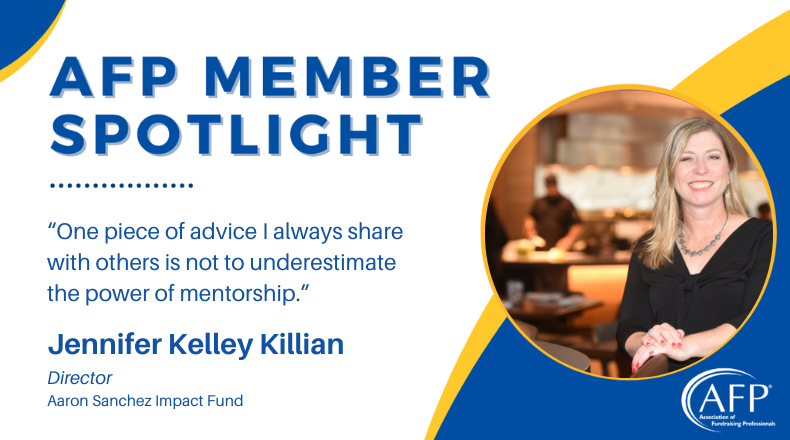
In this member spotlight, we interviewed Jennifer Kelley Killian, director of the Aaron Sanchez Impact Fund, about her path into fundraising and the power of mentorship, creativity, and trust in nonprofit work. Jennifer shares how innovative, hospitality-driven fundraising events and strong professional relationships have shaped her career, from leading emergency relief efforts during COVID-19 to mentoring the next generation of professionals.
Q: How did you start your career in the fundraising profession and what led you there?
A: I was working at a New Orleans-based marketing firm called Valence and often assisted with one of our clients, the Louisiana Hospitality Foundation (LHF). It’s a great organization that provides critical financial resources for hospitality industry workers when they incur an emergency such as an accident, house fire, medical emergency and more. At the time, they were a volunteer-led organization that had never invested in any paid staff. After a few years of supporting their event planning and other marketing tasks, the client approached our agency’s owner asking if they could provide me with an offer to be their executive director. After discussing the opportunity with my employer and my family, I decided to accept the position and dive into my first paid fundraising position, which was in February 2015.
Q: When and why did you decide to become an AFP member?
A: It didn’t take long for me to realize that I needed training and resources to succeed in my new nonprofit role. Thankfully, one of our board members had also held the position of executive director of a local nonprofit, and he became a key advocate for my requests to invest funds for professional development. They sent me to an ED bootcamp, other training sessions, and I joined professional organizations. I quickly learned that fundraising would be a priority and joined AFP in June 2015.
Q: Are you doing anything innovative at your organization (or a past organization) that you think other fundraisers could benefit from?
A: This may be an unpopular opinion, but I love fundraising events. So far, my 11 years in fundraising have been in nonprofit organizations that have missions and networks tied directly to the hospitality industry, and these organizations have produced more events than most nonprofits. In fact, we’ve enjoyed (not loathed) producing events for fundraising. I think this is because we have direct connections to the leaders of these businesses — hotels, restaurants, food suppliers, beverage suppliers, sanitation suppliers, and more — for in kind gifts, sponsorships, table sales, etc., which allows more efficiency and minimizes expenses to maximize the bottom line. EVERY event needs support from the hospitality industry!
We created an event model that was applied multiple times a year that I think is worth sharing - “$1 per item.”
- Fish Fry Fridays: Each Friday during the Lenten season, restaurants and bars featured a seafood dish and donated $1 per item sold to the charity.
- POWER Plates: For the month of July, restaurants and bars featured a food or drink item and donated $1 per item sold to the charity. This also was sponsored by a local bank with a program called POWER that supported female entrepreneurs, so in addition to featuring a dish, each participant also featured a POWERful woman in their business.
We created group marketing campaigns (similar to a Restaurant Week campaign business model) where multiple businesses signed up to be part of a campaign that would bring awareness to their business while also raising funds for our cause. We asked businesses to feature a food or drink item for a period of time then donate post-event based on sales of those featured items. Our organization produced the marketing materials, the campaign website, and pushed messages into the community with press releases, media interviews, social media and more. Businesses (now new donors!) would submit a gift based on their honor system of sales tracking. It was a win-win for everyone involved. We grew awareness for our mission and raised funds!
Q: What is your favorite word? (only one word) How has this word influenced or inspired your career?
A: Favorite Word = Mentor. Early in my fundraising career, almost as soon as I accepted my first role, I asked someone I admired if she had the capacity to be my mentor. That person was Christine Briede, a fellow member of the Association of Fundraising Professionals and former president of the AFP New Orleans Chapter. What started as professional guidance has grown into a relationship that has supported me tactically, strategically, and personally. We still make time for periodic phone check-ins or the occasional lunch, and that mentorship continues to be a meaningful part of my growth.
Over time, the tables have turned. In my role as director of the Aarón Sánchez Impact Fund, a program of Emeril Lagasse Foundation, I now have the opportunity to mentor young people myself. Part of our work includes operating a scholarship for Latino students pursuing culinary arts education, and what makes this experience unique is the mentorship they receive along the way — from me, from Chef Aarón Sánchez, and from other hospitality professionals who align with their career goals.
At a conference recently, I had an “aha” moment when I heard the phrase informal mentor — someone who may not be family or in my program’s case, a chef instructor. An informal mentor is someone who shows up, listens, and makes space for young people to grow. That description resonated with me. I’ve realized how much I value this part of my work, and it continues to inspire me to help create opportunities and meaningful connections every day.
Q: What professional accomplishment are you most proud of?
A: In my former role at LHF, I was the ED and only employee for seven years. Part of that work included the COVID shutdowns where hospitality workers were heavily impacted. I helped lead a partnership with United Way of SELA and LHF called Hospitality Cares that raised $2.4 million to directly support 4,800 hospitality workers across southeast Louisiana. Our emergency grant funds were being dispersed to individuals even before the federal government announced any sort of stimulus programs.
Because of this success, in 2021 I was recognized by New Orleans Wine & Food Experience with an Ella Brennan “Stand Up for Your Hometown” Award which recognized 13 individuals and organizations who stood up for others during a time of extreme stress. I’m still in awe that my name is next to Miss Ella’s in headlines (pinch me!), and proud that we were able to help so many people in such a short amount of time with our United Way partners.
Q: How has being an AFP member and participating in the AFP affinity groups benefited you in your career?
A: Being a member of the Association of Fundraising Professionals has been an important part of my professional foundation as a fundraiser. I often think of AFP as a guiding light for our field. For many years, it has helped shape how I approach my work and continue growing in this profession. I regularly revisit the Code of Ethics, read articles in Advancing Philanthropy, attend local chapter meetings, and explore AFP resources that help me refine my skills and stay grounded in best practices. The insights that come from AFP feel trusted, practical, and rooted in real-world experience.
I also recently attended an AFP Latinx affinity group for the first time and look forward to continuing to participate. I valued the opportunity to hear what others are experiencing in their roles and to be inspired by the cultural perspectives shared in the conversation. I chose to join this group because the demographic closely aligns with the work I do with the Aarón Sánchez Impact Fund, even though I am not personally Latina. It was a meaningful reminder that fundraisers across many backgrounds often face similar challenges and opportunities, and there is so much we can learn from one another.
Q: In your opinion, what is the biggest challenge facing the nonprofit fundraising profession today?
A: In my opinion, one of the biggest challenges facing the nonprofit fundraising profession today is trust. As fundraisers, we have a responsibility to continually build and maintain confidence that we are good stewards of the gifts entrusted to us. Donors want to know that their contributions are being used responsibly and in direct support of the mission they connected with and chose to invest in.
At a time when many people are losing trust in major institutions — whether in government, education, media, and beyond — nonprofits must work even harder to demonstrate transparency and accountability. That means consistently sharing the outcomes of our work, providing clear and measurable results, and keeping an open dialogue with our communities.
We can strengthen trust with both existing and prospective donors by being transparent, responsive, and human in our approach. Personal outreach matters — taking the time for conversations, listening to feedback, and even making a simple phone call can go a long way in building lasting relationships.
Q: What advice do you have for other fundraising professionals?
A: One piece of advice I always share with others is not to underestimate the power of mentorship. As adults, we often have to be intentional about seeking out and building these relationships, which can feel uncomfortable at first — but it’s worth it. A mentor can be a sounding board for challenging conversations, a partner in brainstorming, and someone who helps keep you accountable as you grow in your career. When you’re ready to ask someone to be your mentor, come prepared with a sense of what you hope to gain from the relationship, and be honest about why you admire and respect their work.
Read More