AFP Member Spotlight: Kimberly “Kimm” Lett, J.D.




AFP Member Spotlights are a recurring series of interviews with AFP members, highlighting the unique individuals and career paths that exist within the fundraising profession. If you know an inspiring fundraising professional who deserves to be featured, please email [email protected].
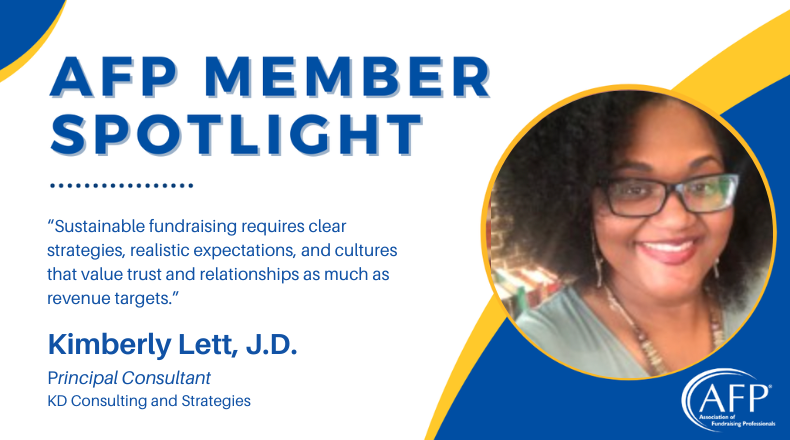
In this member spotlight, we interviewed Kimberly Lett, J.D., principal consultant at KD Consulting and Strategies. She shared how her career evolved from lead generation and revenue strategy into full-spectrum development leadership, with a strong focus on building sustainable, modern fundraising systems. Kimberly also reflected on the importance of innovation, ethical standards, and long-term strategy in creating resilient organizations and a healthier fundraising profession.
Q: How did you start your career in the fundraising profession and what led you there?
A: My entry into fundraising was through lead generation, client partnerships with nonprofit and movement organizations, and revenue strategy work.
For several years, I worked directly with teams designing and executing lead generation campaigns that built supporter pipelines at scale for 501(c)(3) and 501(c)(4) organizations. That experience gave me an in-depth understanding of donor acquisition, segmentation, messaging, and the mechanics of converting interest into long-term engagement, and later, donor investment.
My career transitioned fully into development when I began consulting on a project that I helped design. Through this initiative, organizations received grant support specifically to build out sustainable fundraising infrastructure. I worked directly with these cohorts of organizations to strengthen their online and individual giving programs. I began partnering with leadership teams nationwide to design systems for donor cultivation, retention, upgrades and revenue growth.
Inspired by the work I’d committed myself to, I was moved from the front-end of acquisition strategy into full spectrum development leadership. I began serving in director-level roles and as a senior consultant, focusing on building cross-channel, comprehensive fundraising programs that integrated modern with traditional, relationship-based development. Development became the core of my work rather than a function of it.
Q: When and why did you decide to become an AFP member?
A: As someone who is also legally trained, I understand that fundraising is complex work that deserves standards and continuing education. And as my leadership responsibilities expanded—particularly in development strategy and systems design — it felt important to be in conversation with peers who are thoughtful about fundraising, development, and philanthropy.
AFP represents professionalism and ethical responsibility. It is essential to remain connected to a community committed to these standards.
Q: Are you doing anything innovative at your organization (or a past organization) that you think other fundraisers could benefit from?
A: Much of my work has focused on strengthening revenue infrastructure and modernizing donor strategy. I have led initiatives to:
- Design structured donor onboarding and education journeys that increase retention and lifetime value
- Integrate digital acquisition strategy with mid-level and major gifts cultivation
- Improve cross-functional collaboration between development, communications, branding and marketing, products, strategy, and program teams
- Shift organizational focus from short-term revenue goals to long-term pipeline development
- Centering data and narrative strategies to better understand community of supporters
Innovation, in my view, is not simply about new tools. It is about disciplined strategy, data-informed decision-making, and ensuring that fundraising systems reflect contemporary donor behavior. From my experience, organizations that underinvest in infrastructure and innovation leave significant lifetime donor value unrealized. Sustainable growth requires modern systems, disciplined strategy, and an intentional focus on long-term engagement, not one-time appeals.
Q: What is your favorite word? (only one word) How has this word influenced or inspired your career?
A: Speaking of which, I have to say: Innovation. As I mentioned previously, innovation is essential in fundraising today. Donor expectations, communication channels, and philanthropic behaviors continue to evolve. I’ve seen how organizations that fail to adapt risk stagnation. Innovation has influenced my career by pushing me to continuously assess systems, ask questions, then question assumptions, and identify untapped opportunities. At the same time, innovation must coexist with relationship-building. The most effective fundraising blends forward-thinking practices with deep, human engagement.
Q: What professional accomplishment are you most proud of?
A: I am most proud of building development infrastructure in moments of transition. With multiple organizations, I’ve helped design foundational systems —from recurring donor programs to major gift pipelines to cross-departmental revenue strategy — that positioned teams for growth beyond any one campaign or fiscal year. The accomplishment is knowing that the systems, relationships, and frameworks that I’ve built will strengthen their sustainability.
Q: How has being an AFP member and participating in the AFP affinity groups benefited you in your career?
A: AFP has reinforced that fundraising is both a profession and a community. The affinity groups, in particular, provide thoughtful dialogue around bringing our whole selves into the profession along with understanding sustainability doing this work and the evolving expectations of the field. The connections have sharpened my thinking and reminded me that none of us are building alone.
Q: In your opinion, what is the biggest challenge facing the nonprofit fundraising profession today?
A: The biggest challenge is sustainability — both financial and human. Donor behavior is shifting, digital landscapes are saturated, and many organizations are under-resourced while being asked to do more. At the same time, fundraisers themselves face burnout from constant urgency. Sustainable fundraising requires clear strategies, realistic expectations, and cultures that value trust and relationships as much as revenue targets.
Q: What advice do you have for other fundraising professionals?
A: Focus on long-term strategy. Invest in infrastructure. Collaborate across departments and truly learn your teams. Fundraising does not operate well in isolation; it reflects the strength of the entire organization.
Remember: philanthropy is a shared commitment to impact. Lead with integrity. Steward trust with care.
We are working in a political and economic environment that directly shapes donor behavior and overall funding patterns. The profession is evolving in real time. Fundraisers must remain vigilant and adaptable — continuing to tell compelling stories and build modern practices that respond to the moment while protecting long-term sustainability.

Read More