AFP Member Spotlight: Kulin Matchhar, MBA




AFP Member Spotlights are a recurring series of interviews with AFP members, highlighting the unique individuals and career paths that exist within the fundraising profession. If you know an inspiring fundraising professional who deserves to be featured, please email [email protected].
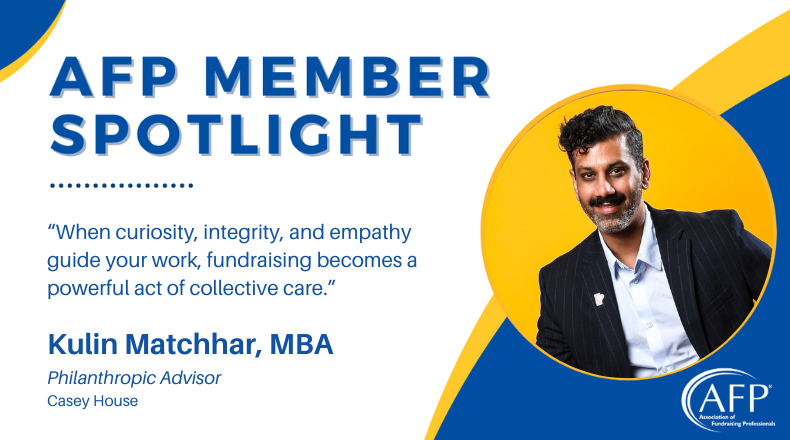
In this member spotlight, we interviewed Kulin Matchhar, MBA, philanthropic advisor at Casey House. He shared with us how his nonlinear path into philanthropy — sparked by early volunteerism and shaped by deep commitments to inclusive, donor centred engagement — continues to guide his work as he helps build a more ethical, connected, and future focused fundraising profession.
Q: How did you start your career in the fundraising profession and what led you there?
A: Like many fundraisers, my path into philanthropy wasn’t linear. I often say I fell into it, which many fundraisers relate to; few plan a career in philanthropy from the start. One of my earliest exposures to giving came through volunteering. In grade seven, a school assignment required 10 volunteer hours. I chose the YMCA and quickly went far beyond the requirement. That experience sparked a lifelong commitment to service, and in high school, I was honoured as YMCA Volunteer of the Year at both the local and provincial levels.
Professionally, I began my fundraising career at Plan International Canada as an associate on the mid-tier giving team. Being part of a newly developing program gave me my first exposure to donor stewardship, impact-driven fundraising, and the role strategy plays in advancing international development. I then joined SickKids Foundation, where I worked across major gifts and gift & estate planning and learned firsthand how one of Canada’s most sophisticated fundraising organizations operates. Collaborating closely with senior leadership laid the foundation for my career in healthcare philanthropy. My academic background in biomedical sciences, combined with an MBA, ultimately led me to Casey House, Canada’s only HIV specialty hospital. Alongside my professional work, my long-standing involvement as a donor and volunteer leader in Toronto’s arts and culture community has shaped how I approach philanthropy, giving me a donor's perspective on the donor journey, not only as a fundraiser but also as a donor. That dual perspective continues to guide how I build relationships and connect people to purpose.
Q: When and why did you decide to become an AFP member?
A: I joined AFP when I became intentional about building a long-term career in philanthropy. I was looking for a professional home grounded in ethics, education, and connection, where I could listen, grow, and learn alongside peers. AFP offered access to conferences, affinity groups, and a community that values generosity of knowledge as much as generosity of resources. AFP and its affinity groups have been instrumental in my growth. Inclusion, diversity, equity, and access (IDEA) is not something I layer onto my work; it is central to how I engage with donors, colleagues, and communities. Affinity spaces have provided mentorship, shared learning, and candid dialogue, strengthening my leadership and reinforcing the importance of ethical, inclusive fundraising practices.
Being part of AFP has also given me opportunities to engage in meaningful discussions about the future of fundraising. At the TOgather 2024 Conference, I participated in a panel on Navigating the Future of Arts and Culture in Canada, exploring how arts institutions can reflect diversity, engage communities, and secure sustainable funding while staying true to their mission. I’ve also attended AFP ICON, the global conference for fundraisers, which broadened my perspective on international trends, ethical practices, and innovative strategies in philanthropy. These experiences have expanded my network, strengthened my professional perspective, and reinforced why AFP is such an essential space for learning, growth, and connection.
Q: Are you doing anything innovative at your organization (or a past organization) that you think other fundraisers could benefit from?
A: At Casey House Foundation, one of the most meaningful shifts we’ve made is reframing how we engage donors across giving levels. While my original job title was leadership gifts officer, it became clear that “leadership” can mean very different things to donors and doesn’t always reflect how people want to participate in philanthropy. In practice, my work spans annual, leadership, major, and legacy giving. Without changing my role, my title became philanthropic advisor to reflect a more holistic, donor-centred approach, advising individuals on how their values, capacity, and interests can translate into meaningful impact over time.
This shift has helped normalize conversations with donors about multi-year and legacy giving and created more inclusive entry points into philanthropy. Similar to how AFP thoughtfully structures affinity groups, I believe organizations can benefit from designing engagement strategies that recognize different communities, motivations, and ways of giving, grounded in ethical practice, transparency, and respect for donor intent .
Q: What is your favorite word? (only one word) How has this word influenced or inspired your career?
A: Curiosity. Curiosity has shaped every stage of my journey, from saying yes to a single ticket to an arts event that changed my life, to asking better questions of donors, colleagues, and myself. If I hadn’t accepted an invitation to what I now recognize as a cultivation event over a decade ago, I don’t think I’d be where I am today. Curiosity keeps me open, engaged, and willing to explore where relationships and opportunities might lead.
Q: What professional accomplishment are you most proud of?
A: I’m most proud of helping lead initiatives that expanded inclusion, representation, and long-term engagement in philanthropy. In my past role at SickKids Foundation, I helped lead the effort for the organization to participate in the Toronto Pride Parade for the first time, marking an important step in inclusive community engagement.
More recently, at Casey House Foundation, my team and I held the organization’s first planned and legacy-giving panels, including sessions focused on the 2SLGBTQIA+ community during Pride Month and for Will Planning Month, creating accessible, community-driven conversations about impact and belonging.
Beyond my professional roles, my volunteer and patron work in the arts has been profoundly rewarding. I serve as a board trustee at the Gardiner Museum, where being invited as one of the youngest trustees reinforced my belief that philanthropy thrives when emerging leaders are trusted and empowered. I also had the privilege of co-founding and co-chairing the Unparalleled Young Patrons Program for Fall for Dance North, and serving as co-chair of the First Position Patrons at Canada’s National Ballet School. These experiences continue to inspire my commitment to engaging and cultivating the next generation of philanthropists, both within the arts and across the broader philanthropic community.
Q: How has being an AFP member and participating in the AFP affinity groups benefited you in your career?
A: AFP and its affinity groups have been instrumental in my growth. IDEA is central to how I engage with donors, colleagues, and communities. Affinity spaces have provided mentorship, shared learning, and candid dialogue, strengthening my leadership and reinforcing the importance of ethical, inclusive fundraising practices. AFP has also created opportunities to exchange ideas, gain insight into emerging trends, and deepen my connection to the broader philanthropic community.
Q: In your opinion, what is the biggest challenge facing the nonprofit fundraising profession today?
A: The profession is at a real point of inflection. Organizations are navigating economic pressure, donor fatigue, and rising expectations around transparency and measurable impact, while also facing a donor retention challenge that cannot be solved by acquisition alone. A persistent barrier, particularly for smaller and mid-sized organizations, is the reluctance to invest in the very tools and people that enable sustainable growth. From personal experience, when friends who are volunteering, serving on boards, or leading small organizations ask me what they should do, I often advise them to invest in trusted vendors, data systems, or digital infrastructure. Their first reaction is often, “We can’t, it’s too expensive.” But in reality, you can’t do it all as a small shop, and a thoughtful investment, whether it’s a vendor, software, or digital platform, can dramatically expand your impact. I’ve seen teams of three scale their digital footprint, improve donor engagement, and generate returns multiple times over by taking calculated risks. Bold thinking, supported by a strategic plan, is essential for long-term, sustainable fundraising.
The next evolution of philanthropy will be driven by better use of data, digital engagement, and responsible applications of AI, not to replace relationships, but to strengthen them. When fundraisers are supported with the right tools and ethical frameworks, they gain more time to do what matters most: build trust, steward donors, and deepen long-term commitment. Sustainable fundraising requires organizations to be as strategic and future-focused as the donors they seek to engage.
Q: What advice do you have for other fundraising professionals?
A: Embrace the non-linear nature of this work and stay grounded in your values. Say yes to opportunities, even small ones, because you never know where they may lead. Invest in relationships, seek mentorship, and engage with philanthropy not only as a fundraiser, but also as a donor, volunteer, and community member. When curiosity, integrity, and empathy guide your work, fundraising becomes a powerful act of collective care.
One of my favourite quotes, which always brings me joy when I read it, is: "In the joy of others lies our own, In the progress of others rests our own, In the good of others abides our own, Know this to be the key to peace and happiness" — Pramukh Swami Maharaj
For me, this captures the essence of philanthropy: the joy, progress, and good we cultivate in others ultimately shape our own fulfillment and purpose.
As I said above, so many of us “fall into” philanthropy; it may not be planned, but it becomes a calling when your curiosity, values, and connections guide you toward meaningful work.

Read More