AFP Member Spotlight: Rizwana Jmari




AFP Member Spotlights are a recurring series of interviews with AFP members, highlighting the unique individuals and career paths that exist within the fundraising profession. If you know an inspiring fundraising professional who deserves to be featured, please email [email protected].
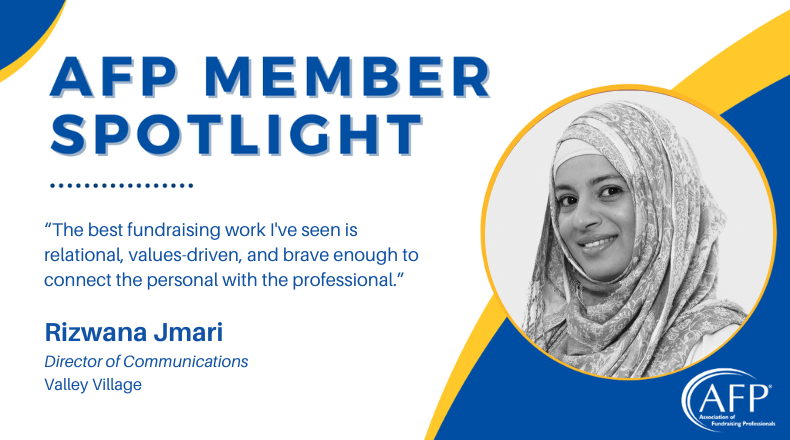
In this member spotlight, we interviewed Rizwana Jmari, director of communications at Valley Village. She shared with us how her background in communications is informing her development work, allowing her to focus on the type of storytelling that truly connects donors to the mission.
Q: How did you start your career in the fundraising profession and what led you there?
A: I never set out to become a fundraiser. In fact, for much of my career, I have worked in communications and marketing across various sectors, including banking, education, and law, both in the U.S. and internationally. Even my academic background is rooted in journalism and marketing communications. My focus was always on crafting messages that moved people, whether to learn more, take action, or feel seen.
When I joined Valley Village, a nonprofit in Los Angeles that serves adults with disabilities, I gradually stepped into fundraising as my communications work began to intersect more deeply with donor engagement. At first, I saw it as an extension of communications and just another way to share our impact. But over time, I began to understand that fundraising isn't just about amplifying a message; it's about creating genuine invitations. It's about building trust, honoring values, and opening a door for people to become part of a collective mission.
I'm still new to the field, and fundraising isn't just a new skill set I'm sharpening; it's a new mindset, rooted in connection, courage, and the belief that generosity transforms lives.
Q: When and why did you decide to become an AFP member?
A: I became an AFP member in 2024 as I began stepping more fully into the fundraising side of my communications work. As a lifelong learner, I knew I needed to ground my practice in solid, ethical fundraising education, and the CFRE caught my attention. However, I also wanted a community where I could learn, grow, and give back. AFP offered all of that: access to best practices, a network of experienced professionals, and a shared commitment to the kind of fundraising that centers purpose, integrity, and impact.
Q: Are you doing anything innovative at your organization (or a past organization) that you think other fundraisers could benefit from?
A: Absolutely! At Valley Village, I completely overhauled our approach by building a structured communications plan as the foundation of the development strategy. Research shows that nonprofits with a 'formal' communications plan are significantly more effective at aligning content with goals and engaging target audiences (Chase Lockshin, 2024). By treating communications as the spine of our fundraising efforts, we can craft donor journeys that feel intentional and impactful.
I built our plan around five key clusters, ensuring that every email, social post, appeal letter, and stakeholder update serves a clear, strategic purpose. A communications-led development approach fosters cross-team collaboration, ensures message consistency, and allows for agile responses to emerging opportunities, all while minimizing redundant work.
In short, a strong communications plan is the engine behind effective fundraising. Communications isn't fluff. It's infrastructure. It transforms one-off donation requests into a sustained, values-driven conversation. One that builds trust, inspires generosity, and deepens long-term relationships.
Q: What is your favorite word? (only one word) How has this word influenced or inspired your career?
A: Resilience. It's a word I return to often, especially in light of a verse from the Quran: "And that there is nothing for man except that [good] for which he strives" (53:39). That truth grounds me. It reminds me that every step taken with intention, no matter how small or unseen, matters. Resilience, to me, isn't about pushing through for the sake of it. It's about showing up with consistency, humility, and hope, trusting that effort itself is sacred. This mindset has shaped how I face challenges and also how I lead, connect, and build toward lasting impact.
Q: What professional accomplishment are you most proud of?
A: I'm proud of the spaces I've stepped into and reshaped with intention, especially those where stories were overlooked or voices underrepresented. Across sectors, continents, and cultures, I've learned to lead with empathy and strategy, often building from the ground up.
Currently, I'm particularly proud of the way I'm bridging communications and development, crafting messaging that not only informs but also builds trust and invites generosity. It's a space where I'm still growing, but one that feels deeply aligned with my values.
Most of all, I'm proud of showing up fully, while lifting others, mentoring emerging professionals, creating space for shared learning, and honoring the stories that often go unheard.
Q: How has being an AFP member and participating in the AFP affinity groups benefited you in your career?
A: Being part of AFP has given me access to mentorship, best practices, and a sense of belonging in the profession. The affinity groups I belong to have been especially affirming. They offer space for identity, authenticity, and community.
Q: In your opinion, what is the biggest challenge facing the nonprofit fundraising profession today?
A: One of the biggest challenges I see is the missed opportunity to build truly integrated, trust-driven donor experiences. Too often, communications and development operate in silos, resulting in inconsistent messaging, disconnected touchpoints, and missed opportunities to nurture deeper relationships.
Even when organizations collect donor data, it's rarely used in meaningful ways. Strategy tends to lean heavily on urgency-based appeals rather than insight-driven storytelling or thoughtful segmentation. In the process, donors can feel more like transactional partners than those with a meaningful impact.
What's needed is a shift: to see communications not as support, but as infrastructure. And to treat data not as a reporting tool, but as a bridge to understanding what donors care about and how they want to engage.
The organizations that will thrive are the ones that design donor experiences with intention: experiences rooted in empathy, clarity, and alignment across every touchpoint. When development and communications work in sync, powered by thoughtful data use, we move from simply raising funds to building lasting, values-driven communities.
Q: What advice do you have for other fundraising professionals?
A: Let your story be part of your strategy. The best fundraising work I've seen is relational, values-driven, and brave enough to connect the personal with the professional. It's not just about dollars. It's about dignity, trust, and transformation.
Read More