Mentorship Spotlight: Vishakha Uppoor, CFRE: Across Borders, Beyond Advice: Reflections on Mentorship, Belonging, and Growth



What began as a cross-border mentorship through AFP’s Women’s Impact Initiative became a deeper reflection on belonging, confidence, and what meaningful professional growth can look like.
When I first learned I had been matched with a mentor in New York through the AFP Women’s Impact Initiative (WII) mentorship program, I was excited for all the obvious reasons. Here was an accomplished fundraiser, and I was stepping into a stage of my career where I was hungry for a clearer sense of direction. What I did not expect was how quickly our conversations would move beyond the usual professional small talk.
During our initial chats, my mentor, Pinky Vincent Shubert, and I discovered that we were both originally from India and had each built our lives in North America through our own immigration journeys. Our stories were not especially similar in their details. We came from different parts of India, had taken different paths, and were at different points in our careers. But there was an immediate familiarity in how we understood the world: certain instincts, anxieties, and ways of moving through professional spaces were already legible to each other. That changed the tone of the mentorship almost from the start.
We often talk about mentorship in very practical terms, and fairly so. It can help you navigate career decisions, networking, and professional development in more intentional ways. But sometimes the most meaningful mentoring relationships do something deeper and, in my experience, more lasting. They help you feel seen more clearly, put words to patterns you’ve been living with for years, and expand your sense of what might actually be possible for you.
This mentorship was cross-border in the literal sense, yes, but it also moved into deeper territory around belonging, ambition, and the quiet stories we carry about what it takes to earn our place.
More than a career conversation
I got the opportunity to participate in the WII mentorship program at a point when I was already asking bigger questions about my career. I was moving into a new phase professionally and trying to make sense of what kind of fundraiser I wanted to become, not just what title I wanted next. From the outside, that probably looked like a fairly ordinary career inflection point. Inside my own head, it was a bit of a circus.
I was thinking about growth, but I was also thinking about the terms on which that growth was happening. Was I challenging myself in a healthy way, or had I quietly convinced myself that I always needed to do more to earn my place? Was I holding myself to a high standard, or to an impossible one?
That is part of what makes programs like the WII so valuable. It created space for conversations that are not only about career growth, but about the internal stuff that sometimes gets edited out of professional development. The connections this program helped foster also exposed me to new perspectives and different ways of showing up as a fundraiser. It pushed me to examine the assumptions I’ve been carrying around for years and ask whether they are still serving me, or whether they are just very well-established mental houseguests that probably should’ve moved out by now. That kind of clarity ended up mattering just as much as any practical guidance I received.
The difference shared context makes
There is a particular comfort in not having to explain yourself from scratch. Being paired with another Indian woman meant there were moments when Pinky understood what I meant before I had fully articulated it myself. There was a shared cultural vocabulary beneath the surface and a kind of recognition that made the relationship feel easy.
We both understood, in our own different ways, how identity can shape confidence. We understood the pressure that can come with wanting to represent yourself well and avoid mistakes in environments where you are often very aware of yourself. We understood how ambition can be layered with caution, and how professionalism can sometimes blur into over-preparation, self-monitoring, or the need to prove that you belong in the room.
These experiences are not always easy to explain in professional settings. They can sound like abstract DEI concepts until someone understands the shape of what you mean in a lived, concrete way. That shared context changed the quality of our exchanges because I didn’t need to translate myself as much. I could get to the point faster, and Pinky could understand and challenge what I was saying with a level of specificity that felt genuinely useful, instead of veering into generic advice. What made this mentorship so valuable in the end was that it was built on recognition, honesty, and the kind of directness that makes you sit back for a second and think, “Well, that was rude of you to be completely correct.”
That shared understanding felt especially significant around the 2025 AFP ICON, where we were finally supposed to meet in person. Seattle is just a hop, skip, and a jump away from Vancouver, so it should’ve been a routine trip. It was not. The conference took place during an unusually tense political moment between Canada and our neighbours to the south, when crossing the border did not feel entirely neutral or uncomplicated. Travelling now carried an extra layer of stress, and Pinky understood that immediately. I didn’t have to explain why the decision felt loaded or why it carried more emotional weight than a typical conference trip might have.
Spoiler alert: I did end up going, and I had a wonderful experience. But that is part of why the trip felt symbolically important. Meeting in person mattered, of course, but so did the choice to cross a border, literally and emotionally, for a relationship that had already changed me from a distance.
Three lessons I’m keeping
Pinky had a way of cutting through my overthinking without dismissing it, which is a surprisingly rare balance to strike. She would often challenge the assumptions I was bringing into a situation and push me to look at things more clearly. Had I set the bar higher than it needed to be? Was I reacting to what was actually in front of me, or to my own habit of overextending? Those conversations left me with three lessons that I hope to carry with me for a long time.
1. Authenticity and professionalism are not opposites
As a neurodivergent woman of colour and an immigrant, I’ve often been conscious of how easily professional success can start to feel tied to performance: sounding a certain way, presenting yourself correctly, and adapting to what feels most acceptable in the room. I’d come across the phrase “authenticity and professionalism are not opposites” on a LinkedIn post, but it was this mentorship journey that made its meaning actually land for me. I became more grounded in the idea that I don’t need to flatten parts of myself to be effective, credible, or taken seriously. I can bring my own perspective, communication style, and way of functioning to my work, and those things are part of what makes my contribution meaningful.
2. Growth is not the same as overextension
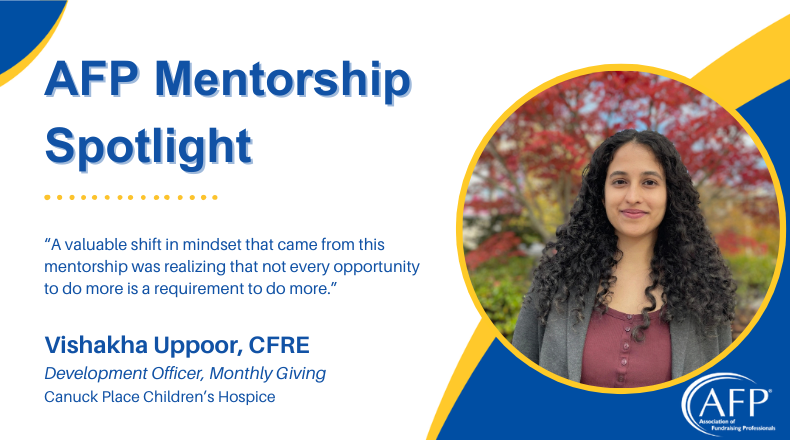
My brain is wired to get excited about ideas, possibilities, and all the things I could learn, improve, or take on. That curiosity is a strength. But left unchecked, it can easily tip into overcommitment, overthinking, and a constant urge to keep pushing past what is actually sustainable. A valuable shift in mindset that came from this mentorship was realizing that not every opportunity to do more is a requirement to do more. Sometimes growth looks less like pushing yourself to the brink and more like developing better judgment, a healthier sense of what is enough, and a way of working that allows you to keep going without burning yourself out.
3. Representation expands possibility
Sometimes you don’t fully realize how powerful it is to see someone who reflects part of your story until it actually happens to you. Seeing another Indian woman who had built a successful career in philanthropy in North America did not hand me a blueprint for my own future, but it did make that future feel more tangible. It helped me see that there is no single ‘correct’ way to build a meaningful career in this profession. Sometimes simply seeing someone whose journey overlaps with yours can make the future feel easier to picture and, in turn, easier to pursue with more conviction.
What remains after the program ends
By the time I met Pinky in Seattle for the conference, it already felt like I was just reuniting with an old friend. We had spent months talking across screens, across time zones, and across all the usual messiness of work and life. Sitting down together only made tangible what had already become real for me.
That moment has stayed with me, along with the realization that the most valuable mentorship is not always the kind that gives you a neat list of answers. Sometimes it gives you better questions, stronger perspective, and a clearer sense of what is actually yours to carry and what never needed to be in your backpack to begin with.
Some mentorships help you make a career decision. Some help you do your job better. And some quietly shift your sense of where you belong. This one did all three. And I would be remiss not to acknowledge the generosity of other mentors who have helped shape my growth and encouraged me to step into opportunities like this one in the first place. That broader support has meant a lot to me and shaped me in lasting ways.
Author Information
Vishakha Uppoor
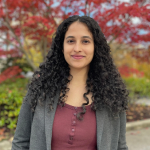 Vishakha Uppoor, CFRE is the Development Officer, Monthly Giving at Canuck Place Children’s Hospice in Vancouver, British Columbia, and a member of the AFP Greater Vancouver Chapter’s Membership Committee. As an immigrant to Canada, she brings a unique blend of cultural insight and a nuanced understanding of diverse perspectives to her work, which informs her efforts to foster inclusive connections through philanthropy and help drive meaningful impact. She’s also an enthusiastic movie buff, with an incurable love for Bollywood films, which continues to fuel her appreciation for the power of good storytelling to inspire, engage and connect people.

Read More