Beyond Borders: Unlocking Generosity Through Culturally Conscious Fundraising

Reflections from AFP ICON on culturally conscious fundraising, Asian Pacific Islander Heritage Month, and the role of culture in defining philanthropy
Asian Pacific Islander (API) Heritage Month in May invites reflection on the histories, traditions, and values that shape how many communities understand generosity, reciprocity, stewardship, and belonging. For those of us in the fundraising profession, it also offers something important: a chance to examine how we define philanthropy..
This was at the heart of our session at AFP ICON when we asked attendees a question: What did giving look like in your life growing up?
The responses: chocolate bars, wrapping paper, magazine subscriptions, silent auctions, raffle tickets, walk-a-thons, read-a-thons, BINGO nights.
Then, we asked a few more questions:
你吃飯了嗎?What if philanthropy includes cooking meals for loved ones? What if giving does not include a tax receipt?
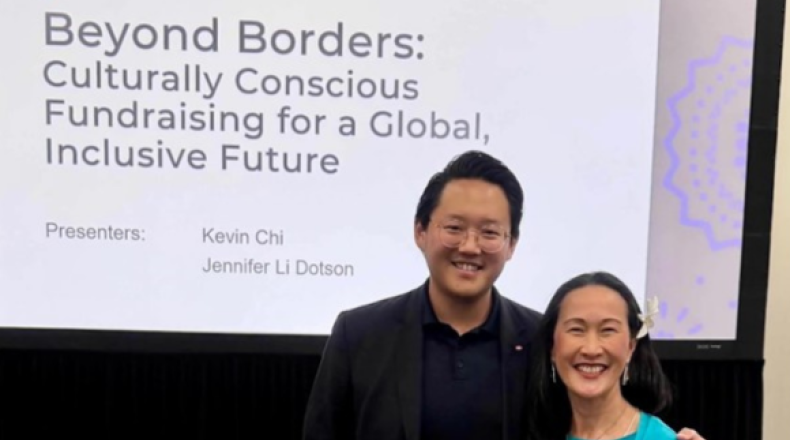
That is why this conversation matters. When we walked into the room for our session, “Beyond Borders: Culturally Conscious Fundraising for a Global, Inclusive Future”, we carried more than a slide deck. We carried lived experience. We carried stories shaped by navigating philanthropy across cultures, countries, and geography.
What unfolded in the room revealed something encouraging. Our profession is open to a deeper, more human conversation about what it means to give.
Philanthropy Is Cultural
At its core, culturally conscious fundraising is about rethinking the assumptions that shape how we engage with donors, communities, and one another. This is why we challenge the notion that philanthropy is a narrowly defined through a lens that focuses only on wealth, recognition, and formal systems.
For both of us, this work is deeply personal.
Kevin brings the perspective of growing up in a Chinese immigrant family in Canada and building his career in healthcare philanthropy in Vancouver. His experience navigating a nonprofit sector that did not always translate easily across generations shaped his understanding of how cultural context influences philanthropy.
Jennifer brings the perspective of growing up as a Vietnamese immigrant in the Pacific Islands, pivoting from an early career as a diplomat and “accidentally falling into” fundraising with firsthand experiences of how generosity is expressed through community, reciprocity, and collective care.
Though our journeys differ, we have each encountered moments when traditional fundraising frameworks felt too narrow to capture the philanthropy we witnessed within our own communities.
The nonprofit sector often defaults to what can be easily measured, centering and reinforcing behaviors that development managers can easily point to during weekly 1:1 meetings: total donation amount, average gift size, frequency of face-to-face meetings, date of last gift, and moves management. These metrics can inadvertently hide the diverse ways people give and miss out on the fuller picture of their philanthropic engagement.
Many communities practice generosity through relational, reciprocal, and collective frameworks that often remain invisible to institutional systems.
Think about practices such as:
Lunar New Year red envelopes (紅包): symbolic acts of blessing, continuity, and intergenerational support.
Mutual aid networks: collective resource sharing among families, neighbors, and communities during times of need.
Family caregiving: long-term financial and physical care for elders, often representing one of life’s most profound commitments.
Hospitality as generosity: welcoming, feeding, and caring for others as an expression of communal responsibility.
These are all acts of philanthropy.
If we misunderstand how people express generosity, we inherently limit our ability to build authentic relationships and foster deeper engagement. Conversely, when we expand our understanding of what giving looks like, we also expand who gets to be part of the philanthropy world.
Developing cultural consciousness and understanding the profound significance in honoring our parents and elders, or family and religious obligations, prompts us to consider reciprocity more deeply when we value giving back to the community.
If philanthropy is ultimately about caring for one another, then culture isn’t peripheral to the work, it’s central to it.
Leading with Cultural Curiosity
Cultural curiosity encourages us to approach donor relationships with openness rather than assumption. The answer lies in relational humility. This requires:
- Deep Listening: Creating space to understand a donor's "why" before seeking to persuade.
- Reflection: Critically examining our own ingrained assumptions about what an ideal donor looks like.
- Willingness to Unlearn: Letting go of ideas that recognition is the goal for every supporter.
This practice develops relational intelligence: the ability to read nuance, navigate complexity, and adapt authentically. These fundraising capabilities create empathy for a profession serving increasingly diverse communities.
Three Questions Before Your Next Donor Conversation
A practical tool we shared at AFP ICON was a simple reflective framework for fundraisers to use before their next donor conversation to cultivate curiosity:
1. What assumptions am I bringing into this interaction? Are you assuming familiarity with institutional philanthropy or comfort with direct solicitation?
2. How might this donor define generosity differently? Could their giving be tied to family obligation, community visibility, or quiet service?
3. Am I prioritizing the relationship or the process? Fundraising systems often reward efficiency, but authentic relationships require presence and patience.
We closed our AFP ICON session by re-examining definitions of generosity and culture, and asking ourselves to reflect: What are the norms, beliefs, and values that each of us brings to creating a culture of philanthropy?
Redefining Philanthropy Will Unlock Generosity
API Heritage Month highlights history and resilience, but for fundraisers, it also extends a profound invitation. It asks us to reconsider: Whose stories of generosity are we telling? Whose traditions are we recognizing?
One of the most meaningful moments of our AFP ICON session happened after it ended. Small groups formed around the room as people continued the conversation. Several shared stories of navigating their own cultural identities within fundraising spaces. Others reflected on the relief of hearing philanthropy discussed in ways that resonated with their lived experiences.
API Heritage Month offers a meaningful opportunity for our nonprofit sector to examine whose definitions of generosity shape our systems and whose traditions remain underrecognized.
Too often, a cultural lens reduces communities to festivals. Visibility is not the same as inclusion. This month let’s acknowledge that histories have been erased, ignored, or misunderstood within formal institutions. It’s a chance for us to embrace new definitions of generosity, and to be culturally conscious when defining philanthropy.
Here is a reminder to stay curious, to lead with openness and curiosity, and to recognize that there is no single correct way to give. Philanthropy becomes stronger when we embrace multiple traditions of generosity.
The Future of Philanthropy
At AFP ICON, our session was called Beyond Borders because generosity itself transcends the imaginary borders we draw for ourselves geographically, socially, and culturally. When we widen understanding of a culture of philanthropy and a culture of belonging, we become more inclusive, we cultivate deeper trust and create practices that better reflect the richness of the communities we serve. That is the future of fundraising.
When diverse voices shape our profession, they illuminate new pathways for engagement. This embodies the spirit of AFP’s FORGE framework, particularly its emphasis on openness, respect, and empathy as foundational professional values.
As we move forward, we have a new commitment to learn and unlearn the way we practice fundraising, to ensure it truly includes everyone.
By the way, this conversation was also never intended to be exclusive about Asian Pacific Islander experiences. It was about creating a way to approach all communities with curiosity and respect.
Moving beyond borders, finding connections and expanding our circles, and approaching new experiences with humility, curiosity, deep listening, and openness to learning are all hallmarks of a new consciousness in fundraising, a new and better way to fundraise.
Keep the Conversation Going
We’ve been reflecting deeply on how to keep this topic alive after meeting so many of you that had great ideas and positive feedback. If you are open to continuing this conversation, we invite you to join us for a free virtual gathering on May 27th where we will revisit our AFP ICON presentation, “Beyond Borders: Culturally Conscious Fundraising for a Global, Inclusive Future.” Join us to continue exploring how to learn why culture matters in philanthropy, and discussing practical strategies to navigate inclusive donor engagement.
Click here to RSVP.
Also, if you’re interested in connecting with a community that shares these values and lived experiences, please check out our private LinkedIn group for the Asian Pacific Islander Affinity Group and consider joining our affinity group meetings.
Our Asian Pacific Islander Affinity Group meets every third Wednesday of the month. Click here to RSVP.
Thank you! Mahalo! 謝謝大家!
 Jennifer Li Dotson, MSc, CAP, is a Strategic Advisor for AI in Fundraising in Tacoma, WA, that serves on the board of AFP South Sound and AFP Advancement Northwest chapters as well as the Finance Committee for AFP Global. She helps nonprofit organizations ethically leverage technology to strengthen engagement and advance equity-centered philanthropy.
 Kevin Chi, CFRE is a Development Officer for the Faculty of Medicine at the University of British Columbia in Vancouver, BC, Canada, an active member of the AFP Greater Vancouver chapter, and serves on the Board for AFP Foundation for Philanthropy - Canada. His work focuses on healthcare philanthropy, donor engagement, and inclusive fundraising practice.

Read More