AFP Board Member Spotlight – Luis Francisco Pacheco Cámara




AFP Member Spotlights are a recurring series of interviews with AFP members, highlighting the unique individuals and career paths that exist within the fundraising profession. If you know an inspiring fundraising professional who deserves to be featured, please email [email protected].
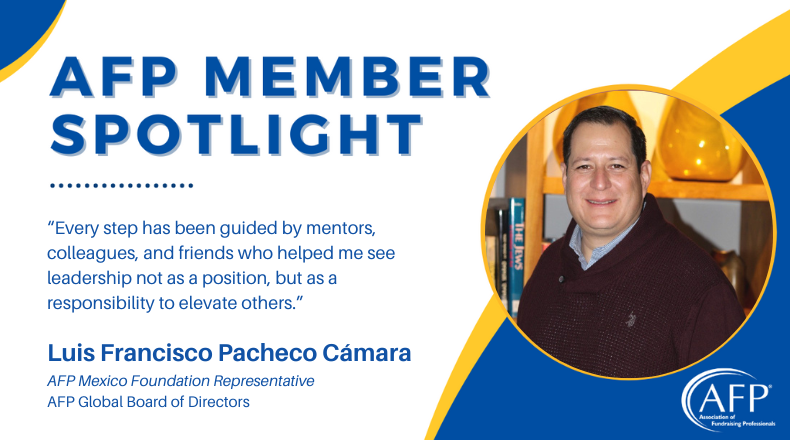
In this member spotlight, we interviewed Luis Francisco Pacheco Cámara, the newly elected AFP Mexico Foundation representative on the AFP Global Board of Directors. He reflects on a 25-year career rooted in community, empathy, and purpose; his journey from grassroots fundraising to AFP leadership; and his commitment to expanding intercultural understanding within AFP so the profession can grow stronger, more ethical, and more connected across borders.
Q: How did you start your career in the fundraising profession, and what led you there?
A: My journey into fundraising began more than 25 years ago, long before I even knew this work had a name. I was part of a small community project that was at risk of disappearing. We had passion, commitment, and a real purpose—but no resources. Out of complete necessity, we started searching for ways to keep the project alive. Those were my first humble steps.
Later, when I joined a university, I was asked to formally train in fundraising to establish its first development office. Yet beneath the professional responsibilities, my motivation was always deeply personal: every effort, every campaign, every ask was tied to a human story—real people facing real needs. Fundraising, for me, became a vocation rooted in dignity, empathy, and the desire to make sure meaningful work never fades for lack of resources.
Q: When and why did you decide to become an AFP member, and how did you become a volunteer?
A: My first encounter with AFP was back in 2005 at a hemispheric conference in México City. I walked into that event thinking I understood fundraising—and walked out transformed. AFP opened my eyes to the depth, ethics, and global perspective of our profession.
When I returned to Guadalajara, I discovered a group of fundraisers dreaming of founding a chapter. I joined them, inspired by their vision, and soon became part of the founding process of AFP Western México. That community shaped me. And attending my first ICON? It was unforgettable—a moment when I realized I was no longer walking alone in this profession.
Q: Can you share with us a little bit about the path you took within AFP that led you to board service?
A: AFP has been a true home for my professional growth. Within my chapter, I had the privilege of serving as ethics chair, education chair, vice president, and president. Each role taught me more about service, integrity, and the power of community.
These experiences eventually led me to AFP Global, where I served on multiple committees and task forces and joined the advisory council of the AFP México Foundation. Every step has been guided by mentors, colleagues, and friends who helped me see leadership not as a position, but as a responsibility to elevate others.
Q: What is one skill you think is invaluable as a fundraising leader?
A: Empathy. Not the soft, abstract kind—but deep, courageous empathy. The kind that allows us to truly enter someone else’s story, honor their dreams, and invite them to co-create change with us. Fundraising is not just about resources; it is about forming genuine, honest, and lasting human connections. Without empathy, that is impossible.
Q: What is your favorite word? How has this word influenced or inspired your career?
A: Community. Throughout my life, community has been the place where meaning is born and where purpose takes root. It is where one learns, dreams, fails, rises, and returns transformed. Community is both our starting point and our destination. It is where we understand the world and where we commit to building a better one. That belief has shaped every project I’ve ever led.
Q: What professional accomplishment are you most proud of?
A: Beyond awards, campaigns, or milestones, what fills me with pride is encountering people—students, colleagues, volunteers—who I had the privilege of mentoring or accompanying and seeing who they have become. Witnessing their growth, their compassion, and the impact they now make in the world is the most meaningful accomplishment of my career. Their success is my most profound joy.
Q: In your opinion, what is the biggest challenge facing the nonprofit fundraising profession today?
A: In Latin America, our context is unique. Inequality and violence deeply affect our communities, and in the midst of these realities, philanthropy often struggles to take root. The uncertainty surrounding fundraising discourages many young professionals, creating a shortage of new leaders in the sector.
We face an urgent need for professionalization across the nonprofit field. And yet, I firmly believe the region holds extraordinary potential—if we nurture talent, strengthen ethics, and create communities of practice that empower emerging fundraisers.
Q: What is one goal you have for your time on the AFP board?
A: To expand intercultural understanding within AFP.
I hope to help AFP Global look toward new horizons—toward other geographies, other realities, other voices. My goal is to help build a community of communities, where diversity is not just represented but celebrated, and where global learning flows in every direction.
Q: What advice do you have for other fundraising professionals?
A: Two words: Hope and purpose.
Hope keeps us moving, even when challenges seem overwhelming. Purpose reminds us why this work matters—because behind every project is a human life waiting to flourish. When fundraisers lead with hope and purpose, we don’t just raise money—we help transform the world.
And yet, no fundraiser can carry this vocation alone. We all need a community of reference, a circle of colleagues who remind us of who we are, why we serve, and what is possible. Community grounds us, strengthens us, and helps us stay ethical, resilient, and inspired. In a profession built on relationships, belonging to a community of peers is not just helpful—it is essential to our growth and to sustaining the heart of our work.

Read More