AFP Board Member Spotlight – Mary Paxton, MNA, CFRE




AFP Member Spotlights are a recurring series of interviews with AFP members, highlighting the unique individuals and career paths that exist within the fundraising profession. If you know an inspiring fundraising professional who deserves to be featured, please email [email protected].
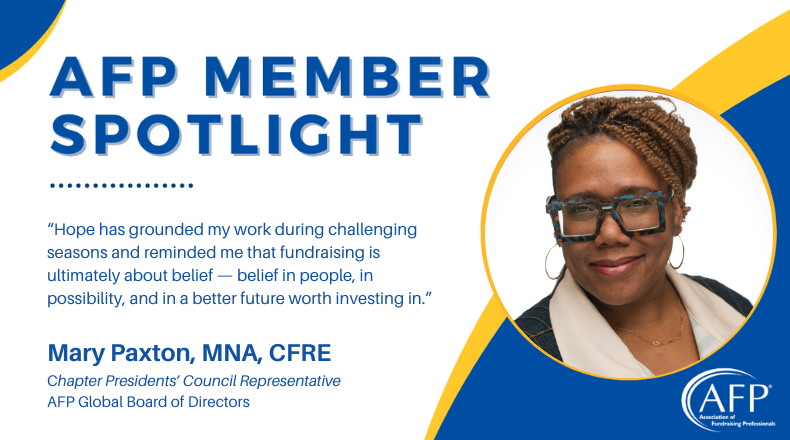
In this member spotlight, we interviewed Mary Paxton, MNA, CFRE, the newly elected chapter presidents’ council representative on the AFP Global Board of Directors. Mary reflects on her path into fundraising, her leadership journey within AFP, and the importance of listening, hope, and sustainability. She also shares her commitment to elevating chapter voices and strengthening connections across the AFP community.
Q: How did you start your career in the fundraising profession and what led you there?
A: I often say I fell into fundraising rather than intentionally choosing it. Early in my career, a mentor introduced me to a nonprofit organization, Lutheran Metropolitan Ministry, whose mission is “to promote peace, well-being, justice, and right-relationships.” That mission deeply influenced my career path in the nonprofit sector and was also where I was first introduced to aspects of fundraising. What began as grant writing and donor support evolved into a passion for building strong systems, telling compelling stories, and connecting people to causes that truly matter.
Q: When and why did you decide to become an AFP member and how did you become a volunteer?
A: I was first introduced to the AFP Greater Cleveland Chapter during my master’s program in 2007. I joined for a period of time but later stepped away while raising my children. In 2019, one of our past presidents reached out to personally invite me to re-engage through the IDEA committee and board service. As I became more involved with the chapter and began attending AFP ICON and AFP LEAD events, I found myself connected to a broader professional community. As a fundraiser of color navigating the profession, I was not only seeking professional grounding, but also a meaningful way to help shape the field and give back.
Q: Can you share with us a little bit about the path you took within AFP that led you to board service?
A: I began my involvement with AFP by joining our chapter’s IDEA committee and shadowing the committee chair. The following year, I joined the board, served as co-chair, and eventually became vice president of the IDEA committee. That path ultimately led me to serve as the first person of color to be elected board president. During that time, I was invited to attend a PAC reception at an AFP LEAD event, which sparked my interest in AFP Global engagement. I went on to join several global committees. I noticed the CPC application for 2025, but I felt it was important to gain additional experience before applying. When the opportunity came again to serve in 2026, I felt ready — and I applied.
Q: What is one skill you think is invaluable as a fundraising leader?
A: Listening. Truly listening — to donors, colleagues, boards, and communities — builds trust, sharpens strategy, and ensures that fundraising remains values-aligned and mission-centered.
Q: What is your favorite word? (only one word) How has this word influenced or inspired your career?
A: Hope. Hope has grounded my work during challenging seasons and reminded me that fundraising is ultimately about belief — belief in people, in possibility, and in a better future worth investing in.
Q: What professional accomplishment are you most proud of?
A: Serving as director of advancement at Villa Angela–St. Joseph High School is one of the professional accomplishments I am most proud of. When I stepped into the role, many people questioned why I would take it on, as the school was widely expected to close. The school was a merger of an all-boys and an all-girls Catholic high school, each with long and proud histories. There was significant alumni resistance and disengagement.
Through intentional relationship-building, transparent communication, and a shared vision for the future, we were able to re-engage alumni from both legacy schools, restore confidence in the sustainability of the school, and build buy-in around a new path forward. Today, the school is standing strong, revitalized with a new athletic gym, a new football field, and a renewed sense of community and purpose.
Q: In your opinion, what is the biggest challenge facing the nonprofit fundraising profession today?
A: Burnout — driven by increasing demands, shifting funding landscapes, and unclear role boundaries. Addressing this requires better leadership, healthier organizational cultures, and a renewed commitment to sustainability for fundraisers themselves.
Q: What is one goal you have for your time on the AFP board?
A: As chapter presidents’ council representative, my goal is to elevate the voices, needs, and strengths of local chapters and help strengthen collaboration across chapters. I want to ensure that chapters feel heard, supported, and connected to AFP Global in meaningful ways, while also sharing best practices and lessons learned across the network.
Q: What advice do you have for other fundraising professionals?
A: Prioritize self-care, know your non-negotiables, and build your network — you are not in this alone. Take advantage of opportunities to learn, lead, and grow, even when they stretch you.

Read More