AFP Member Spotlight: Crystal Downs




AFP Member Spotlights are a recurring series of interviews with AFP members, highlighting the unique individuals and career paths that exist within the fundraising profession. If you know an inspiring fundraising professional who deserves to be featured, please email [email protected].
In this member spotlight, we interviewed Crystal Downs, strategic donor communications manager at Sinai Chicago. Crystal’s path to fundraising began with freelance writing and a grant proposal that unexpectedly launched a decades-long career. Today, she channels her passion for storytelling to highlight the impact of Sinai’s work, build a culture of philanthropy within the organization, and encourage fundraisers to embrace adaptability to meet ever-changing community needs.
Q: How did you start your career in the fundraising profession and what led you there?
A: It’s interesting, because I was freelance writing for small businesses and nonprofit clients—event scripts, brochures, press releases, speeches—that sort of thing. In 2000, a nonprofit client wanted to apply for a City of Chicago Empowerment Zone grant and asked if I could write one for them. I tried to steer her to someone else, because I looked at that particular type of writing as something altogether different (which it is!). Also, I looked at it with dread, isn’t it like writing a research paper every day?!
She liked my writing and was adamant that I try. I worked on one of two they submitted (the other done by a professional grant writer). The one I wrote got funded, the other did not. I was hooked thereafter. I later began to specialize in government grant proposals. Yes! It is like writing a research paper every day, but I loved the adrenaline rush and sense of accomplishment when much-needed programs were funded in our communities.
Q: When and why did you decide to become an AFP member?
A: I was working full-time at an FQHC and the agency paid our memberships. Our chief development officer suggested that I apply for the AFP Fellowship Program. The experience was amazing. Our small cohort of five fellows, from across the city, had the opportunity to meet the presidents and CEOs of some of the top funding agencies in Chicago. We not only learned from them and the best fundraisers in Chicago; we learned from each other and the challenges faced by each agency—big, small, arts, health, LGBTQ+, Black, Latino, homeless advocacy—you name it. It was like being “in the room where it happens,” realizing that what we are doing as fundraisers matters to the shaping of our city. Others may not understand our field much … “uhm, developing what?” … but amongst colleagues, we know it’s more than “rattling the tin cup,"—our work is rewarding and can be transformational.
Q: Are you doing anything innovative at your organization (or a past organization) that you think other fundraisers could benefit from?
A: At Sinai, we are fortunate to have the renowned research of the Sinai Urban Health Institute (SUHI), one of the top in the nation on community health. This amazing in-house ace has informed a vast majority of our targeted wrap-around programs in the delivery of urban health. However, though Sinai has been around for 105 years, we’ve only recently been building up a culture of philanthropy within our organization’s leadership ranks (around 2016). In a safety-net healthcare system with two campuses, four hospitals, two institutes and over 10 clinics, the focus is on the needs and health of the community. Saving lives is the prime directive—fundraising can get lost in the list of priorities. But, we have been raising an awareness of the need to tell our stories, track the statistics, and meet with funders. Our efforts are beginning to take hold, with managers and leaders initiating conversations with development, alerting us to the challenges and triumphs in the work that they do.
Q: What is your favorite word? (only one word) How has this word influenced or inspired your career?
A: Pivot. Following the Covid-19 pandemic, I’m sure this word became a “favorite” (smile) of many in our field. But I really like the idea. I like the challenge of the need to think of innovative ways to reach an audience and express your needs now. Your team may need to put aside everything for the sake of the communities that we serve. Whether it be a pandemic, new legislation, an emerging population of clients, or an epidemic. We experience the exhilaration of being on the frontlines of the response—skilled, ready, willing and capable of providing the resources our patients and clients need.
Q: What professional accomplishment are you most proud of?
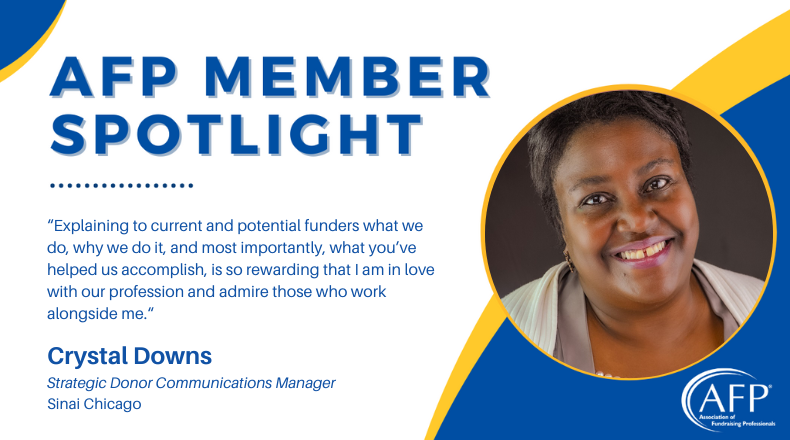
A: I’m happy to have found my niche in fundraising. There are so many aspects to fundraising, that all roads sound exciting! I’ve found my happy place in telling the stories around our system. Not just the patient stories, but that of our dedicated professionals. Explaining to current and potential funders what we do, why we do it, and most importantly, what you’ve helped us accomplish, is so rewarding that I am in love with our profession and admire those who work alongside me.
Q: How has being an AFP member and participating in the AFP affinity groups benefited you in your career?
A: I’ve only recently signed up for affinity groups and hope to get more involved. Being in healthcare, we’ve had our head on a swivel lately and we are constantly putting out fires or sending up flares. I joined the affinity groups because I miss the camaraderie of those in other agencies with different perspectives. When I have a chance to come back to base, I will definitely take the opportunity to chill, learn, reflect, and strategize with others who care about what’s needed for certain demographics.
Q: In your opinion, what is the biggest challenge facing the nonprofit fundraising profession today?
A: Uncertainty. Our ability to meet the needs of our clients can depend on a vast amount of variables—and that’s just for the identified needs. Pivot. The word is crucial, because new challenges crop up, some affecting the existing need, some entirely new to your catchment areas. And as new needs emerge, are our funders also facing a shifting foundation? Our profession requires that we understand both sides of philanthropy and come together well-versed in how we can partner to achieve our mutual goals of sustainability.
Q: What advice do you have for other fundraising professionals?
A: Let’s partner more. We’ve had dips and spikes in philanthropic funding priorities over the decades I have been in fundraising and when times get lean, the big agencies can take the whole pot. Those in smaller organizations should really utilize the resources of an AFP membership and make their programs and “access” known so that they might be a line-item with the bigger institutions—or to partner with other local agencies to make a stronger case for your outreach. Also, individually, if you’re feeling burnt out, don’t give up on fundraising, there are so many wonderful options in our field. You’ll find your happy place.
Read More