AFP Member Spotlight: Evelyn Chen




AFP member spotlights are a recurring series of interviews with AFP members, highlighting the unique individuals and career paths that exist within the fundraising profession. If you would like to see yourself or a colleague featured, submit your profile here.
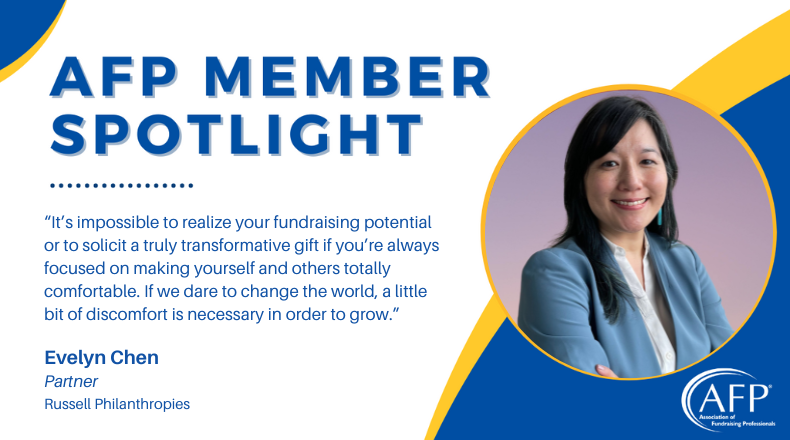
In this member spotlight we interviewed Evelyn Chen, partner at Russell Philanthropies. She shared with us how, as a fundraiser, sometimes it is necessary to embrace discomfort in order to be truly transformative.
Q: How did you start your career in the fundraising profession and what led you there?
A: I started my fundraising career when I was in my 20s. I had no idea what kind of career I wanted to pursue, but knew I wanted to do something that felt meaningful to me and that I could be passionate about. At the time, I was volunteering with a local nonprofit, and was amazed by how good it felt to be part of the solution even in a very small way. So I started interviewing for fundraising roles in the nonprofit sector, because that was the most natural transition from the sales and marketing work I was doing in the corporate sector. I was fortunate to land a role at an organization that was a great fit for my personality and interests, and realized pretty quickly that I both had a knack for and enjoyed fundraising. I’ve been learning and growing in the field ever since.
Q: When and why did you decide to become an AFP member?
A: A fundraiser friend who is a board member of the AFP New York City Chapter invited me to some AFP events last year, and I was so impressed by the programming and community. When I decided earlier this year to leave my frontline fundraising role at a national nonprofit to transition into consulting, one of the main reasons I did so was because I wanted to take everything I had learned throughout my career to help fundraisers at organizations of all sizes to be more successful in securing the support they need. With this goal in mind, becoming a member of AFP and getting more involved in my local chapter was at the very top of my to-do list. The fundraising successes I’ve had are in large part due to the generosity of other fundraisers who supported and taught me along the way, and I knew that engaging in AFP would be a perfect way to give back to our profession in this next phase of my career.
Q: How has being an AFP member benefited you in your career?
A: I’m still a relatively new member, but in even a few short months being an AFP member has enabled me to meet so many interesting, smart people—both through local chapter events, and across the country and internationally through the online forum and events. I’m a nerd who loves talking about fundraising, and it’s delightful to find so many other people with similar interests. I especially like how AFP has made it so much easier for fundraisers at all levels to ask for and offer advice; the true power of AFP lies in all of its members and the wealth of knowledge we have to share with one another.
Q: Are you doing anything innovative at your organization (or a past organization) that you think other fundraisers could benefit from?
A: I don’t think this should be innovative, but one thing I’ve learned over time is the importance of pursuing the shortest, most direct path. Fundraising is often mystified, but it doesn’t have to be that complicated. In my last frontline fundraising role, I led a national grants team that secured $31M with only four full-time staff and some fractional resources. We achieved this by truly working as a team to pursue a joint fundraising goal, reallocating resources as priorities shifted so that we could remain agile and opportunistic, and created a culture of resource-sharing that resulted in a library of template resources that expedited delivery of high-quality proposals and reports to funders. We rarely met with donors more than 2-3 times before submitting a proposal; made sure to align our request (amount, purpose, etc.) by being direct in our questions to funders about their expectations as well as their capacity to give; and always turned around proposals and requests for information very quickly (it was not uncommon to submit a concept within two weeks or less, possible only because we were very aggressive about repurposing materials). Even—and especially—at smaller organizations, there is a lot that can often be done to ensure you and your team are always pursuing the highest value activities in the most efficient manner possible. Time is your most valuable resource and you won’t be able to do everything; so what will you choose to do today?
Q: What is your favorite word? (only one word) How has this word influenced or inspired your career?
A: Discomfort has a lot to teach us about where we need to grow. I learned this from a donor who expressed that as a cis white woman (not to mention a very famous and successful actress!) being comfortable is a privilege. She had learned that whenever she felt uncomfortable in an unfamiliar situation, it signaled that she had something new to learn—and instead of trying to make the feeling go away, she would lean in.
Many of us are working towards missions that are trying to change the world in some way, and yet we shy away from discomfort, which can often mean that we’re asking for too small a gift—shortchanging both the organization and the donor from reaching their shared ambition. It’s impossible to realize your fundraising potential or to solicit a truly transformative gift if you’re always focused on making yourself and others totally comfortable. If we dare to change the world, a little bit of discomfort is necessary in order to grow.
Q: What professional accomplishment are you most proud of?
A: While I’ve raised a lot of money and built programs and initiatives that I’m happy to put on my resume, I am most proud of the teams that I’ve built and the individual careers that I’ve supported during my journey. Early in my career I read "The Five Patterns of Extraordinary Careers", and I knew that my role as a people manager—helping others to learn and find success—would be the highest impact legacy I could pursue. A great leader invests in and lifts up others, to build programs and teams that are successful without them.
Q: In your opinion, what is the biggest challenge facing the nonprofit fundraising profession today?
A: Given how critical philanthropic support is to a nonprofit’s ability to survive and thrive, I am continually shocked by how little understanding or support there often is for these critical roles and responsibilities. How many of us have reported to someone who had unrealistic expectations for how much money could be raised in a given timeline, often without sufficient resources? How many of us have encountered colleagues who talk about “reaching into a donor’s pocket” as if fundraisers were bamboozling them into making a donation? Too many leaders and boards mean well, but don’t fully understand what it takes to deliver philanthropic revenues in a sustainable manner. Until this changes, fundraisers will always be fighting an uphill battle, and we will continue to see the high turnover that hobbles fundraising programs.
Q: What advice do you have for other fundraising professionals?
A: At my last organization, I had the opportunity to work with a professional career coach. Even though my company paid for it, she only advised me and did not report to anyone at my organization. This woman changed my life. At the time, I was a senior vice president, had helped to more than double both the size of the fundraising team and revenues, and my boss wanted me to succeed her as CDO. But I was also terribly overworked and burned out, with no end in sight, and was thinking about resigning because I didn’t know what else to do.
Working with a coach, I learned to set boundaries (it was common for me to take on additional work even at the expense of my own well-being, especially if it prevented my team from being overworked); to have more confidence in my own instincts but to also address my weaknesses (because I’m such a workaholic, I’ve learned to proactively choose situations that will enable me to make healthier decisions); and to recognize that it was ok to not want to be promoted to CDO. After just a few months of coaching, I was able to clearly articulate to my boss what I did and didn’t want, helped to recruit the next CDO (who is doing great!), and ended up having the most successful fundraising year I had ever had in my career—while also finding a better balance between work and life outside of work. If you’ve never tried working with a career coach, I can’t recommend it enough. It might just change your life!
Read More