AFP Member Spotlight: Julia Thompson




AFP Member Spotlights are a recurring series of interviews with AFP members, highlighting the unique individuals and career paths that exist within the fundraising profession. If you know an inspiring fundraising professional who deserves to be featured, please email [email protected].
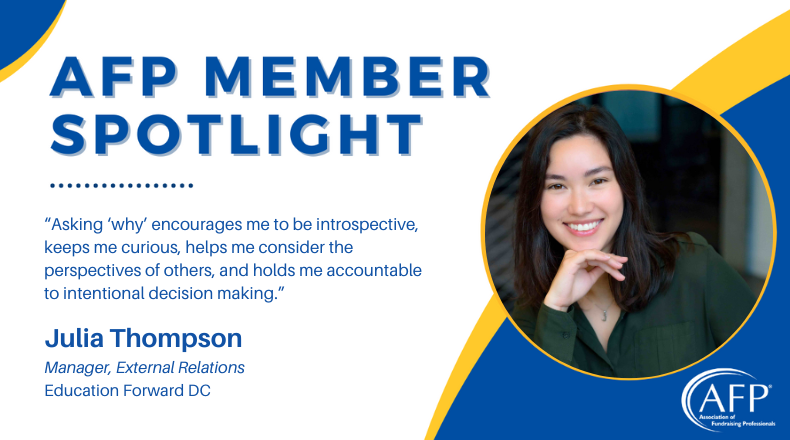
In this member spotlight, we interviewed Julia Thompson, manager, external relations at Education Forward DC. She shared with us how her passion for equity and education led her to fundraising. She is now an active member of the AFP D.C. chapter where she has found a community of peers and mentors.
Q: How did you start your career in the fundraising profession and what led you there?
A: Sometimes I say I fell into fundraising, but it was really an intentional career decision that led me to a fundraising role. A few years ago, I decided to leave my role in public sector consulting to pursue a role in education. I was open to exploring a range of job functions, but focused on finding an organization working toward a future where all students, no matter their background, have access to a great school that equips and empowers them to chart a fulfilling life path. This led me to Education Forward DC. I was especially drawn to the organization's local focus and its commitment to supporting students starting furthest from opportunity. At the time, Ed Forward DC was looking to grow its external relations team, and I felt my skills in project management, relationship-building, and writing would serve as a strong foundation for a fundraising role.
Q: When and why did you decide to become an AFP member?
A: I became an AFP member about a year into my current role. As an early career professional new to fundraising, I sought a community where I could meet peers and mentors in the profession, access educational resources and training, and stay informed of industry news and trends.
Q: Are you doing anything innovative at your organization (or a past organization) that you think other fundraisers could benefit from?
A: Our organization is constantly thinking about how to work with partners—both locally and nationally—to share best practices in fundraising and improve our fundraising capacity as a collective. As a local intermediary, we secure, sustain, and steward resources to support DC's local education leaders. In addition to making investments, our organization provides grantees with individualized support to strengthen their organizational capacity and sustainability—which includes finance and fundraising. Our team discusses fundraising strategies with grantees during check-in's and maintains a list of funding opportunities to share. We are also working to identify shared grantee needs, challenges, and requests related to fundraising to inform how else our organization, as an intermediary, could further support our local partners. We are similarly thinking about how to work with partners to improve our own fundraising practices—notably, meeting with peer intermediaries nationally to share best practices and consider opportunities to collaborate on funding opportunities.
Q: What is your favorite word? (only one word) How has this word influenced or inspired your career?
A: The word I often come back to is "Why?" Asking "why" encourages me to be introspective, keeps me curious, helps me consider the perspectives of others, and holds me accountable to intentional decision making.
Q: What professional accomplishment are you most proud of?
A: In my prior role as a public sector consultant, I got a glimpse into the world of fundraising when I led the preparation of a federal grant application that successfully secured $12 million for a multi-state transportation project. The application process was challenging, as it involved coordinating across varied—and often conflicting—stakeholder interests, influencing senior leadership, and managing a team of 12 to produce outputs along tight timelines. Additionally, my experience with grants at the time was limited—I had only worked on one other application prior. This meant learning on the go.
As someone who sometimes doubts myself and is constantly thinking about how to do things better, my mentors have reminded me to reflect on my successes—and this is an experience I am particularly proud of. Beyond the dollars awarded, this experience gave me confidence, showing me that I am capable of embracing and executing challenging work in a high-stakes environment.
Q: How has being an AFP member and participating in the AFP affinity groups benefited you in your career?
A: AFP has provided a wonderful range of resources to support my personal and professional growth. The discounted access to both online and in-person trainings offered to AFP members has encouraged my knowledge development and skill-building. As a young professional, I appreciate the spaces AFP DC offers to connect with peers and mentors. I have started to develop a network of colleagues through local lunch and learns, happy hours, and career coaching sessions hosted by the local DC chapter. I have also found community through AFP affinity groups, where I have valued the opportunity to meet other fundraisers with similar backgrounds and discuss shared challenges.
Q: In your opinion, what is the biggest challenge facing the nonprofit fundraising profession today?
A: The current economic, political, and technological environment has created heightened uncertainty that brings with it many other challenges. In a high-stakes, results-driven profession, we may face pressure to compromise on core values to deliver short-term results. When this challenge arises, we must remain steadfast in our north star and core values, using these to drive our decision-making. Uncertainty also fosters stress, fear, and isolation—in this environment, endurance and effectiveness as a fundraiser requires we stay connected with and not lose our empathy for one another.
Q: What advice do you have for other fundraising professionals?
A: I would encourage other fundraisers who are new to the field to start building a community of peers and mentors. Lean on this community when you need a compassionate ear, a new perspective, or sound advice. Talk about the elements of fundraising you find rewarding and challenging, brainstorm professional development opportunities, and share insight into organizational practices and culture. Similarly, I would encourage those who have more experience in the field to offer guidance to younger professionals. I have been so appreciative of those who have approached me at networking events or offered their time to me as a mentor.

Read More