Still Pressing On: The Jordan Thomas Foundation 20 Years Later

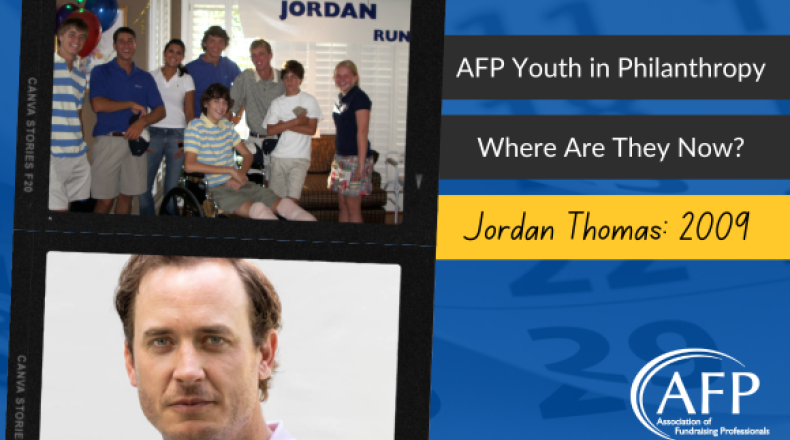


In 2009, AFP honored Jordan Thomas with the William R. Simms Award for Outstanding Youth in Philanthropy for his work founding the Jordan Thomas Foundation, a 501(c)(3) nonprofit dedicated to helping kids impacted by limb differences.
Jordan started the organization in 2005 after losing both of his legs in a boating accident. Realizing how many kids were facing similar circumstances without access to the prosthetics they needed, Jordan decided to commit his life to helping those children and their families.
20 years later, Jordan Thomas and his foundation are still as dedicated as ever to this important mission. Today we catch up with Jordan to hear about the impact his foundation has made over the past two decades, how the work has evolved, and how he has personally grown since starting this work at just 16.
Q: You were just 16 when you experienced this life-changing accident, and yet, in the midst of your own recovery, instead of focusing on your own personal challenges, you chose to start this foundation dedicated to helping others. Can you share a little bit about what inspired you and what your initial goal was in starting this organization?
A: When I started the Jordan Thomas Foundation it wasn’t out of a monumental notion that I’d change the world; I simply saw an injustice and wanted to do something about it. Growing up, my parents had taught me that privilege is something that is meant to be passed on to others who don’t have the same opportunities, and I recognized during my recovery that I was in a position of privilege. Prosthetics are not covered by insurance. I was fortunate enough that my family was in a financial position where we could afford them, but the reality for many kids is that their access to prosthetics depends on their family’s finances. This felt fundamentally wrong to me, and I wanted to do what I could to fix it — and as a result, the Jordan Thomas Foundation was born.
Q: Starting a foundation as a teenager isn’t easy, particularly in 2005 before social media became mainstream — so, what did your early fundraising efforts look like, and how did you begin building support for your mission?
A: It was definitely a very analog effort, heavily rooted in community. I look back fondly on my recovery because of how engaged the people of Chattanooga were and how strongly they rallied behind me with this outpouring of love and compassion. We started our fundraising efforts selling bracelets that said Press On JT — this is in the Livestrong bracelets era — to the people we knew, and then the people they knew, and it just kind of grew from there!
Q: It has now been 20 years, and the foundation has done some incredible work, supporting over 150 kids across 28 states and 3 countries. Can you tell us a little bit about how the organization has grown and how you’ve expanded both your fundraising and the services you provide?
A: As we’ve grown, community has remained a core element of both our fundraising and the services we provide. We now have a singer/songwriter night. We have golf tournaments. But a lot of our fundraising is still based on that peer-to-peer fundraising model and encouraging the families we serve to share their stories to engage their communities, which also generates organic media coverage to help spread the word. Probably like a lot of AFP’s members working at small nonprofits, we’re still trying to figure out the best way to get in front of the people who can write the transformative checks.
In terms of the services we offer, at the beginning we were solely focused on providing children with prosthetics until they turned 18, but based off of my own experience, I knew that there was so much more than that to limb loss. When I got my prosthetics, everyone thought, oh, he is walking again, he must be okay, but in reality, I still had emotional wounds that were just as, if not more, impactful than my physical wounds. This inspired us to expand our mission to think wholistically, adding mental health services, support for families, summer camps, scholarships—programming that addressed the underlying needs of connection and community that are extremely important, but often less visible.
Q: You have done an amazing job over the last 20 years of building this community. What has been the impact of that for the kids, and for you too, as I’m sure you can relate to a lot of what they’re going through?
A: I consistently hear from the kids who participate in these programs that this was the best week of their year, and they’ve built relationships that will last a lifetime. It can also be life changing for the families as well, who get the opportunity to share their experiences and their knowledge with other parents who are facing the same challenges. For me personally, it reignites my passion for this work and puts a face to the name of the people we’re helping, which encourages me to go out there and continue fighting on their behalf.
Q: So, you started the Jordan Thomas Foundation when you were still in high school. What has your personal career journey been like? What is your role with the foundation today?
A: My level of involvement has fluctuated. Early on I was extremely engaged, but as I got older, I felt like I was supposed to explore other options just because I was at the age where most people are figuring out what they want to do with their life. Looking back, I had figured it out at 16. I lost my legs, but I gained a sense of purpose. It just took until about five years ago for me to come back to that realization and start to dedicate myself fully again to the foundation.
Since then, I’ve been wearing about a hundred different hats. As a consultant I do a bit of everything — fundraising, partnerships, marketing, attending events — and it’s amazing the growth that we’ve seen in all of our metrics since I’ve gotten back involved. There is definitely a direct link between my involvement and our recent success, because I am so passionate about this mission.
Q: So, it sounds like there has been an element of professionalizing, taking the foundation from a highschooler-run start up to a full-ledged nonprofit?
A: Very much so. When we started, it was me and my parents, and the board was made up of people that we knew who wanted to help out. Now we have two full-time staff members, and the composition of the board is based strategically on the needs of the foundation and the different skillsets that each board member brings. There are more personalities to navigate, and different opinions to consider. I’ve learned that sometimes it’s necessary to make concessions, even though it is my name on it, because we have a fiduciary responsibility to our donors.
Q: What advice would you give to young people who want to start a philanthropic project or nonprofit?
A: I would first say, find out if there is another organization that is already addressing the need that you want to address. When I started the Jordan Thomas Foundation there wasn’t, but for a lot of nonprofits, they can end up siloed, feeling like they’re competing for dollars because they’re trying to start an independent initiative that is duplicating efforts. If you are serving a new need, or you’re approaching something from a new angle, I would still suggest finding ways to collaborate for the collective benefit of the community you’re serving. They say if you want to go fast go alone, if you want to go far go together — that can be applied to nonprofits.
Q: What’s next for you and the Jordan Thomas Foundation? Are there any new initiatives or goals you’re especially excited about?
A: There’s a couple of different areas that I’m excited about. On a personal note, I’m currently working on my master’s degree in clinical mental health, so I am better equipped to help with that aspect of our services.
We’re also looking at ways that we can make what we do more sustainable for the long term.
Getting back to the reason I founded the JT Foundation in the first place, prosthetics are still not covered by insurance despite the changes in healthcare policy that we’ve seen in the last 20 years. We’ve been working to raise awareness among lawmakers about this by bringing our kids to the Hill to testify and meet with representatives. For them, and for the insurance lobby, this is purely financial, but seeing the kids and hearing their stories humanizes this issue, which has led to some real progress. The coalition So Every BODY Can Move, which is dedicated to ensuring that access to mobility and independence is a right, has helped pass policies in nine states. We plan to continue to be a part of these collaborative efforts with the hope that insurance coverage for prosthetics will free up funds to invest more in community-focused initiatives.
In the meantime, we’re exploring other ways that we can make prosthetics more affordable. Most of the innovation that we’re seeing in the prosthetics market is focused on high-tech projects like integrating prosthetics with brainwaves, but if that prosthetic still costs $125,000, that isn’t beneficial for the community we’re serving. We want to explore if the foundation can manufacture our own prosthetics in a more cost-effective way, without sacrificing quality.
If you’d like to partner with the Jordan Thomas Foundation, we’d love to collaborate! Email [email protected] or call us at 615-455-5505. You can also support the foundation by donating here.
Press on!
Interested in honoring inspiring youth in your community? Applications are currently open for the 2026 William R. Simms Award for Youth in Philanthropy, sponsored by Carter. Submit your nomination by December 19, 2025.

Read More