Where AI Fits in Fundraising: Adoption Without Overreliance

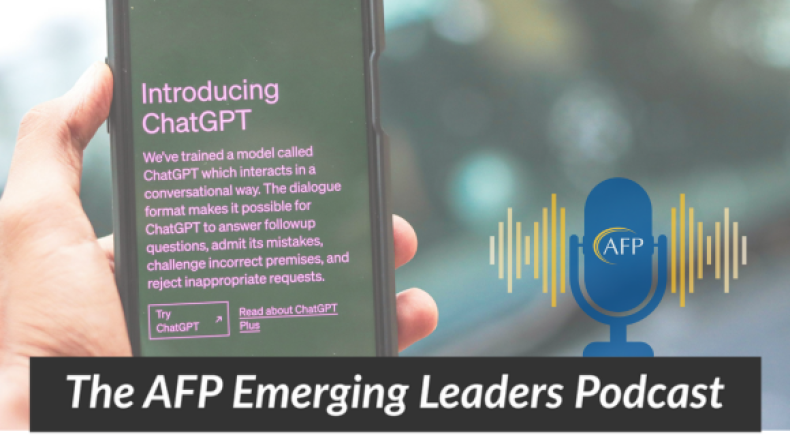
“The more you use generative AI, the better it is going to learn to mimic you, your tone, your voice. The problem with that is, we are letting go of a part of who we are…. We constantly should be exploring who we are or we’re going to get to the point of AI telling us, this is who you are, this is what I know about you,” Meena Das, told guest host Allison Strekal on AFP’s most recent episode of Rising Voices of Fundraising: The AFP Emerging Leaders Podcast.
The facilitator of two practices, NamasteData and Data Is For Everyone, Meena is the go-to expert on AI in fundraising. While a strong advocate for AI and its potential, Meena also cautions against losing ourselves in the process, and emphasizes the role of ethics, equity, self-exploration, and guardrails around AI adoption.
Here are some of the highlights from our insightful interview.
Where are we as a sector when it comes to AI adoption?
Meena shared findings from the AI Equity Project, a three-year study reflecting on equity, AI adoption, who we are as a sector when it comes to AI. Notably, only 10% of study participants felt that their organization was fully ready to implement this technology at a staff level, indicating that our industry as a whole is still in an early, exploratory stage. As further evidence, Meena explored three key takeaways that demonstrated some of the gaps that are holding us back from fully embracing artificial intelligence.
- AI use is still task-based, not mission-oriented. Many fundraisers are experimenting with generative AI tools like ChatGPT or Claude to help them complete specific tasks, such as writing thank you letters or appeals. What most nonprofits are still missing, however, is broader, organizational-wide AI adoption for the purposes of driving their mission forward.
- We need more comprehensive training on AI. You’ve likely attended a one-off webinar here or there on AI (AFP has plenty you can check out!), but there are not yet many formal training programs dedicated to comprehensive upskilling on AI.
- AI is much more than the tools we’re currently using. If you’re using AI, you’re likely using generative AI tools like ChatGPT, or add-ons to your current systems such as your CRM, but AI goes far beyond these tools, with additional capabilities that most organizations haven’t tapped into yet at all.
How can early adopters encourage their organizations to move towards setting clear AI policies?
For those fundraisers who are ahead of the curve with their AI usage, we asked Meena her advice on how to move the needle towards wider adoption. For her, conversation is key. You’re likely not the only one at your organization using ChatGPT. Initiating a conversation about these tools during your team meetings both allows the opportunity for advanced users to connect with one another, and brings skeptics into the dialogue, helping to get all members of the organization to the same page—an essential first step towards the mission-driven AI usage currently lacking from our sector.
Is there a danger of becoming too reliant on AI, to the point where we lose essential skills?
We asked this question specifically in the context of emerging leaders, who are still developing their core fundraising skills, but Meena warns even those who have been in the field for decades are at risk of overreliance. She recalls a discussion at a recent conference where someone suggested the best way to make sure that your voice continues to come through when you use AI to facilitate your writing, is simply to train the AI to mimic your tone and understand your audience. She conceded that this will work, to an extent, but what we’re losing if we do this is bigger than just our voice as a writer. We risk letting AI completely define who we are by what it knows about us. In order to maintain your identity as an individual, Meena reiterates the importance of self-improvement outside of the AI world. “If you like reading books, maintain your time for reading books,” she says. “If you enjoy going out with your friends on the weekend, and learning new skills, I still need to be able to do that, so I can come back over the week and feed those things into the prompt to make sure that whatever comes out of it, it has my voice. My voice is feeding AI, and it is not the other way around.”
Meena goes on to share some of the most important AI related skills that fundraisers should be developing, some of the common misconceptions about AI, and her hope for the future of AI and equity.
To learn more, check out the full podcast episode, and subscribe to AFP’s Emerging Leaders Podcast for new episodes, coming out the third Thursday of every month.

Read More