Ally, Advocate, and Leader: Defending Threatened Missions Ethically & Authentically

In 2025’s charged political and social climate, nonprofit leaders face challenges that go far beyond budgets and fundraising goals. The missions we serve—whether rooted in immigration, disability rights, education, or social services—are under increased scrutiny and, in some cases, direct attack. As a person with positional authority, I’ve grappled with how to respond—not just as a development professional but as an advocate for the individuals our organization supports.
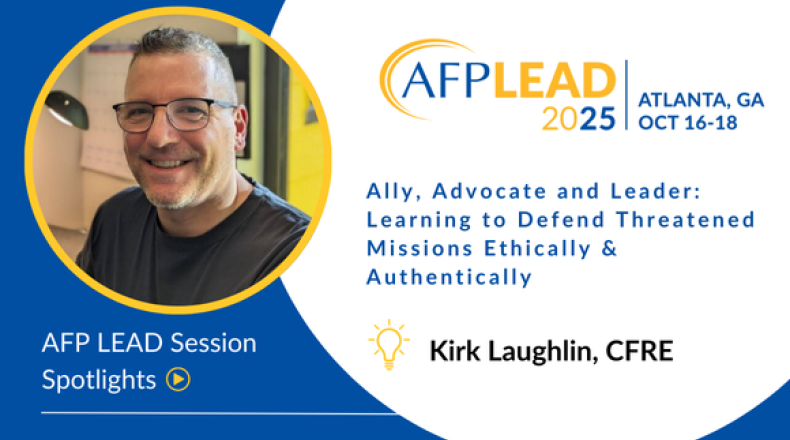
This evolving concern is the focus of my upcoming session: Ally, Advocate, and Leader: Defending Threatened Missions Ethically & Authentically, which I will be presenting at AFP LEAD in Atlanta this October.
This isn’t just a theoretical discussion. It’s about the real-world tension of leading in fundraising when silent neutrality can be just as damaging as funding cuts. Drawing on 30 years in fundraising and two decades as a nonprofit leader—including my current role at Refugee Women’s Alliance (ReWA) in Seattle, WA—I’ll share practical examples of how leaders can leverage their personal and professional privilege to protect clients, empower staff, and defend organizational missions.
My own investments in this topic are professional and personal. I have led fundraising for organizations serving immigrants and refugees, people with disabilities, and individuals facing mental health and emotional challenges. I also have family and personal connections to many of the same mission-areas in which I’ve worked. I would wager that many nonprofit leaders have a similar mix of connections to their missions. And that’s why I believe this conversation cannot wait. Many of us have experienced financial downturns and shifting political priorities in our careers. But today’s environment is different. High-level rhetoric that devalues immigrants, refugees, people with disabilities, and other marginalized groups has reshaped policies and funding streams. It has also publicly devalued many groups of individuals in generalized way.
At my organization—and I’m sure the experience is similar for many others—these shifts aren’t solely about budgets or changes in service delivery. They are personal and often designed to instill fear. At my current organization, nearly all of the staff, department leaders, and board members are immigrants or first-generation Americans. Like the clients we serve who are newcomers to the U.S., my colleagues are facing increased legal scrutiny and unfair political rhetoric. This is not just the usual ebb and flow of nonprofit work; it’s a test of how we, as leaders, can use our credibility and influence when our missions come under fire.
Every leader possesses some form of privilege—whether through demographics, titles, or access to donors and boards. I want to explore how we can use those privileges ethically to uplift and empower, rather than overshadow, the communities we serve.
Each organization’s response to these challenges will depend on its own unique circumstances. With that in mind, my session will be highly interactive, because the best insights will come from our collective experience. It will include:
- Case studies from my own experiences navigating real-world threats
- Breakout discussions where participants share their insights on advocacy and influence
- A 30-day commitment exercise to help you carry this work back to your organization
My hope is that you’ll walk away with more than just notes—you’ll leave equipped with tools and ideas to defend your mission with courage and authenticity. I won’t claim to have all the answers, but I will bring honesty, lived experience, and a firm belief that neutrality is no longer a safe or ethical stance—for our profession or for the communities that rely on our organizations’ missions.
If you’ve ever felt the tension between protecting funding and speaking uncomfortable truths… wondered whether to “tone down” advocacy for fear of alienating donors… or struggled to balance leadership with an authentic defense of your mission during a crisis—this session is for you. I hope you’ll join me for a meaningful conversation and to share your insights.
Join us in Atlanta, October 16–18, for AFP LEAD 2025—three days packed with leadership training, networking, and inspiration tailored to fundraisers and nonprofit professionals. Don’t miss this opportunity to strengthen your leadership skills and connect with peers who share your passion for fundraising and career development.
Kirk W. Laughlin, CFRE has been a fundraiser & nonprofit leader in the Seattle area since 1994 & holds a Master’s in Nonprofit Leadership from Seattle University. During his career, he has taken on leadership roles as a general administrator, financial director, and top executive for organizations serving the mission areas of arts & culture, education, and volunteer service. He’s led fundraising for missions related to education, disabilities, and neurodiverse youth. He is currently chief development officer of Refugee Women's Alliance, one of the largest and longest-serving agencies empowering immigrant & refugee families in the Puget Sound Region.

Read More