Climbing the Pyramid: Unlocking Donor Motivation with Maslow


Moves Management (Moves) remains an industry-leading approach to major gift strategy. Moves is an excellent system for evaluating how close a major gift prospect is to making the gift of a lifetime. If you are unfamiliar with a standard Moves track, CCS Fundraising defines Moves as a client moving through a series of stages: identify, qualify, cultivate, brief, solicit, and steward. For the definitions of each stage, click the link above.
Real donor-centric activity should occur at all stages of the Moves cycle, and is most impactful in the ‘cultivate’ stage; this will be our focus today. CCS Fundraising defines cultivation as “build the relationship by sharing stories and information.”
Cultivation is the messy middle of Moves. When you think about it, it’s the stage that is the least tactfully defined. “Just build a relationship” sounds as easy as “just raise money.”
You could send event invitations, but what if they don’t like in-person gatherings?
You could send good news over email, but what if they’re not adept at reading email?
You could send good news through the mail, but what if they want to save the trees?
You could invite them to meet with senior leaders, but what if their schedule doesn’t allow it?
Let’s take a step back. Building a relationship can be daunting, and it takes time. I can’t, in good faith, say I can provide the exact recommended steps to raising your next $1 million gift.
But what about a recommended mindset?
Maslow’s Hierarchy of Needs is a model of human psychology, organized in a pyramid. According to Maslow, human beings move through five levels of need: physiological, safety and security, love and belonging, self-esteem, and self-actualization. You cannot advance to the next level until the needs of the previous sections are satisfied. And if you move backwards, you cannot skip steps to move back up to your previous level. If you ask me, Maslow’s Hierarchy is Moves Management for human psychology.
Over the rest of this article, we’ll briefly examine each level of Maslow’s Hierarchy and apply them to the cultivation cycle of major gifts fundraising. Each section will have a list of some questions you can answer for each donor—if you can confidently answer each question, you can likely move onto the next level.
Physiological, Safety & Security - Basic Human Needs
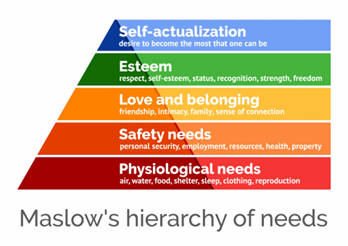
According to Simply Psychology, the first two levels of Maslow’s Hierarchy feature biological needs and societal structure. Physiological Needs include water, food, and sleep. Safety Needs include health, employment, and family.
There is little we can do as fundraisers to influence these levels of the pyramid for a major gift donor. While the needs are survival-related and beyond our control, gift officers need to pay attention to the context clues that might reveal a potential issue. We should never ask a donor to consider a proposal or increase their engagement while they are in crisis. In fact, if you are the relationship manager for this person, consider putting a temporary hold on automatic content, such as annual giving mailers, to reduce the risk of adverse reactions.
A bouquet of flowers or a condolence card could be a memorable step to showing a donor that you value them as a person, not just a funder.
Some questions to consider:
- Is the donor healthy?
- Are there any ongoing critical family events that are prioritized at this time?
- Is the donor in good standing with their employment?
- Are there natural disasters going on in their home area?
Love & Belonging - Finding Connection
Moving to the next level of the pyramid, Love and Belonging, this is where true cultivation begins. According to Simply Psychology, the needs at this stage center on friendship, connection, and belonging.
This is often the moment when a donor’s relationship with your organization starts to take shape. It might begin with a first meeting or phone call, where you ask questions like, “What do you do for work?”, “How did you find our charity?”, or “What part of our mission resonates with you most?” These conversations aren’t about solicitation, they’re about understanding who your donor is and earning their trust.
Some donors at this level find connection through shared experiences. Inviting them to an event, for instance, allows them to meet others who care about the same cause and see themselves as part of a larger community.
Timely and thoughtful stewardship is also key in this stage. A prompt tax receipt is a basic responsibility, but a handwritten note or personal phone call turns a transaction into a relationship. As one mentor once told me, “The tax receipt goes to the accountant; your handwritten note stays on the fridge.”
Some questions to consider:
- Does your donor reach out to you directly with questions, comments, or concerns?
- Does the donor have any personal connections to your mission?
- Do you have the donor’s preferred contact information?
- How many times per year does the donor want to hear from you?
Self-Esteem - Personal Achievement
Now that you’ve established trust and begun to understand your donor’s motivations, you can engage them in the next stage of the pyramid: self-esteem. According to Simply Psychology, this level includes achievement, recognition, and status.
At this point, personalization becomes essential. Donors should clearly see the impact of their philanthropy; what it has accomplished in the past, what it is making possible today, and what it could empower tomorrow. This isn’t the time for generic updates or automated acknowledgments; it’s the time for thoughtful, specific communication that reinforces the donor’s sense of contribution and value.
Less mail merges, more details.
Tell stories that reflect their unique connection to the mission. Bring up stories that only someone close to the work would know. Keep it human, avoid templated messaging, and resist the temptation to let AI write on your behalf.
Collaboration can only elevate this process. Bring colleagues together to brainstorm ways to recognize and engage your donor meaningfully. A collective effort can uncover creative approaches that help donors feel truly seen and appreciated.
Some questions to consider:
- Have you sent the donor a personalized stewardship letter from leadership or a beneficiary?
- Does your donor publicly affiliate with your organization?
- Is your donor active with a volunteer board for your organization?
- Is your donor eager to reach the next highest level of your membership program?
Self-Actualization - Realizing Potential
We have reached the final step of the pyramid, Self-Actualization. According to Simply Psychology, this level includes creativity, achieving meaningful goals, and experiencing purpose.
At this point, your role has transformed to concierge engagement manager, rather than fundraiser. Your donor is fully aligned with the organization and wants more. Ideally, they are acting on their personalized plan to get involved with the strategic direction of the organization.
In well-functioning organizations, it serves in your best interest to have multiple internal stakeholders involved with the donor’s relationship. The added personal connections create a powerful web of pathways for which the donor can build trust, feel understood, and see the organization as a community rather than a single point of contact. This web not only strengthens the donor’s sense of belonging but also ensures continuity. If one staff member leaves or shifts roles, the donor’s relationship to the mission remains intact. Over time, this collective stewardship transforms the donor’s connection from transactional to deeply relational, anchored in shared purpose rather than individual personalities.
Some questions to consider:
- Is your donor ready and eager to join the Board of Directors?
- Has your donor initiated the major gift conversation with you?
- Did your donor set a lifetime goal for their philanthropy with your organization?
- Is your donor willing to host a fundraising or engagement event to engage their network?
Final Considerations
We can’t expect anyone to live the perfect life. It is likely that they will move up and down the pyramid as time goes on, and that’s where our skills as a gift officer come in. It is up to us to recognize context clues and life events then adjust our strategy. Just like driving a car, you hit the gas or the brakes when your surroundings dictate the situation—and sometimes the circumstances change fast.
Transformational giving usually doesn’t happen overnight. Philanthropy Works held a survey that showed it can take upwards of three years and six touchpoints. A majority of this time is spent in cultivation, and by deploying an approach led by Maslow’s Hierarchy, you can gain a better understanding of the human psychology that is occurring as you go.
As I said before, at the end of the day, we are humans working with humans. The personal connections we foster can lead to powerful results that can change the lives of everyone involved, especially the beneficiaries of your organization’s mission.
 Ryan Zapolski is a Cleveland-based fundraising professional and community leader. As Director of Development for Smile Train, the world’s largest cleft-focused organization, he manages a portfolio of major donors and leads the organization’s prospect research efforts. Prior to Smile Train, Ryan held annual giving and major gifts fundraising roles in Higher Education.
An active voice in Cleveland’s civic and nonprofit community, Ryan serves on the Leadership Council for the Cleveland Leadership Center. He is also Vice President of Communications for the Association of Fundraising Professionals of Greater Cleveland, overseeing all marketing and external communications. Since relocating to Cleveland in 2021, Ryan has been passionate about advancing community engagement and leadership development across Northeast Ohio.

Read More